Senior FEED Leadership Across Complex Gas Pipeline and Compressor Infrastructure
Sector: Oil & Gas / Power & Energy Infrastructure
Client: Confidential
Location: Asia
Project Value: Confidential
Asteria International Services: Project Management | Engineering Management
Project Overview
Asteria International provided senior project and engineering management during the Front End Engineering Design (FEED) stage of a complex natural-gas infrastructure project in Asia.
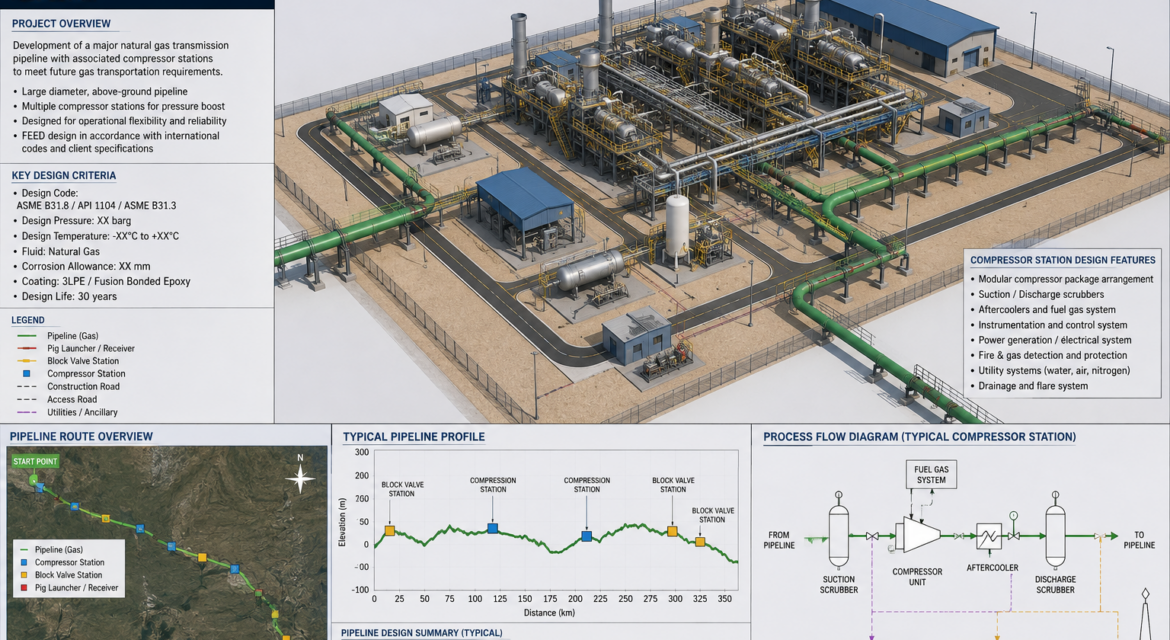
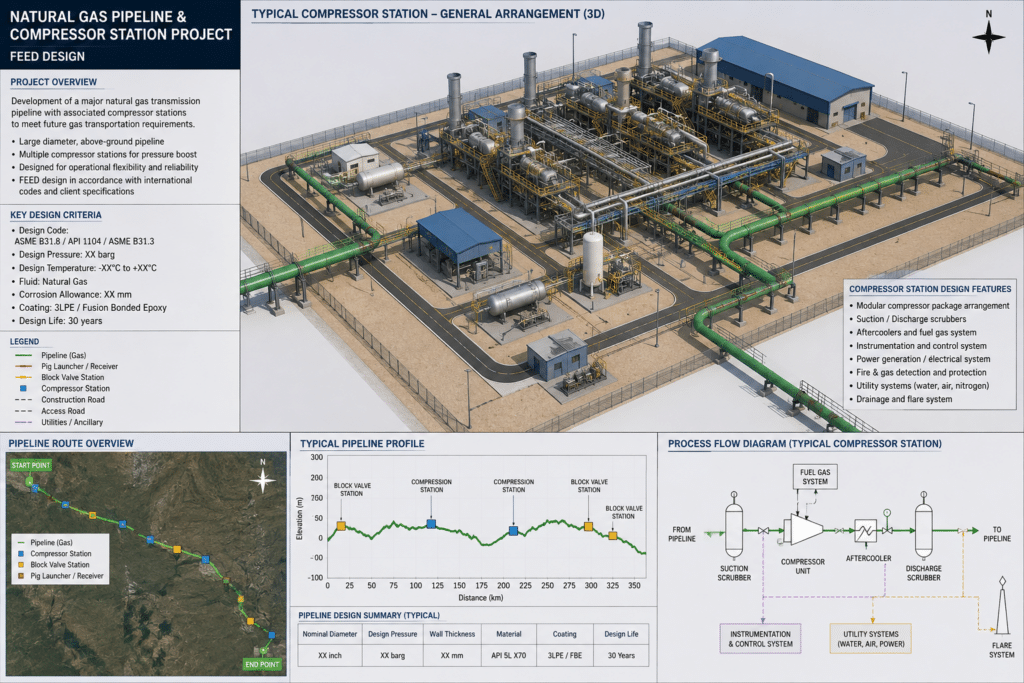
The development comprised a large-diameter above-ground natural-gas pipeline together with multiple compressor units and associated infrastructure, forming the initial phase of a substantially larger strategic pipeline development.
The FEED required coordination across pipeline engineering, compressor systems, process and mechanical engineering, civil and structural works, electrical infrastructure, instrumentation and controls across a geographically extensive project.
Asteria International provided senior management and coordination across the multidisciplinary FEED, maintaining visibility of engineering interfaces, project schedule, project controls, technical deliverables, design maturity, constructability, risk and the requirements necessary to establish a robust basis for subsequent EPC delivery.
The role focused on bringing together the different engineering disciplines and specialist organisations involved in the FEED so that the developing technical definition remained aligned with the wider project requirements.
The Challenge
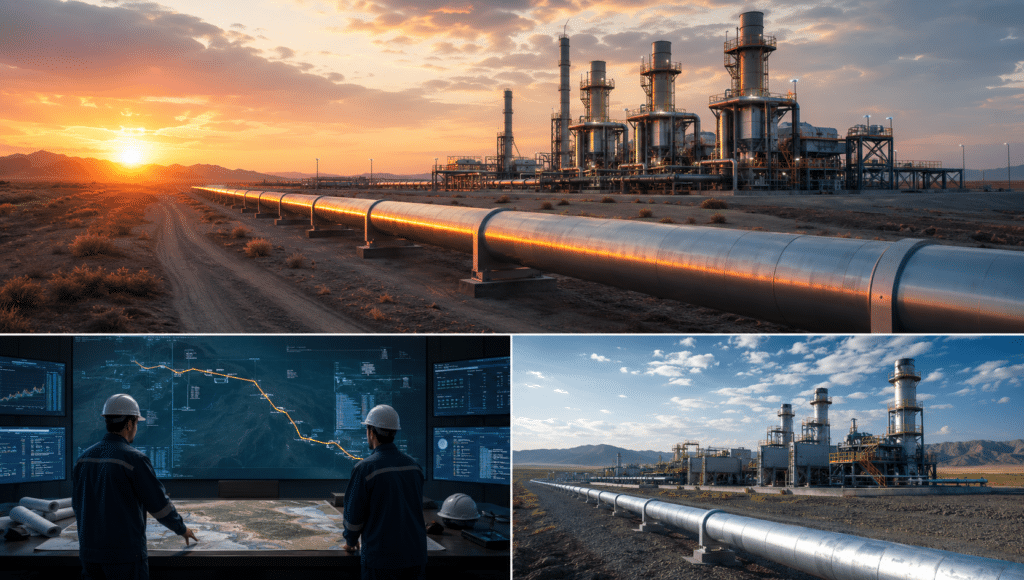
Major gas-transmission infrastructure presents significant challenges during FEED because decisions taken at this stage establish many of the technical and execution parameters that influence subsequent project performance.
The proposed development combined a substantial above-ground pipeline system with multiple compressor units required to support the operating requirements of the gas-transmission network.
Pipeline routing, hydraulic requirements, compressor duties, process conditions, materials selection, civil and structural requirements, electrical infrastructure, instrumentation, controls and constructability all needed to develop as parts of an integrated system.
The geographical extent of the infrastructure, together with the operating and environmental conditions associated with the project location in Asia, created additional complexity.
Engineering decisions needed to recognise not only technical performance but also construction methodology, access, logistics, environmental conditions, equipment transportation, maintainability and the practical requirements associated with delivering major linear infrastructure.
The challenge was therefore to develop a technically coordinated and sufficiently mature FEED capable of providing a sound basis for subsequent EPC execution.
Asteria International’s Appointment
Asteria International provided senior project and engineering management across the FEED project.
The appointment included:
- Senior FEED project and engineering management
- Client interface and stakeholder management
- Multidisciplinary engineering coordination
- Engineering and technical-interface management
- FEED schedule development, planning and forecasting
- Project reporting and governance
- Technical deliverables management
- Pipeline engineering interfaces
- Compressor-system engineering interfaces
- Process and mechanical engineering coordination
- Civil and structural engineering interfaces
- Electrical, instrumentation and controls coordination
- Design review and technical assurance
- Constructability and execution-strategy interfaces
- Procurement and long-lead equipment considerations
- Project risk and opportunity management
- Technical change management
- Project controls and performance reporting
- Engineering maturity assessment
- EPC readiness and FEED close-out
The role required coordination across multiple engineering disciplines and specialist organisations, maintaining visibility of how individual technical workstreams contributed to the overall project definition.
Specialist engineering remained with the relevant engineering disciplines and technical organisations, while Asteria International’s role focused on project leadership, engineering management, multidisciplinary coordination and the interfaces necessary to progress the FEED towards a sufficiently mature basis for the next project phase.
Managing a Multidisciplinary FEED
The success of FEED on infrastructure of this scale depended upon the individual engineering disciplines developing as an integrated design.
Pipeline requirements influenced compressor duties and operating philosophy. Compressor-system development influenced process, mechanical, electrical and control requirements. Routing decisions affected civil and structural design, construction methodology, logistics and future maintenance.
These relationships created significant dependencies across the project.
Asteria International managed the multidisciplinary interfaces throughout FEED, maintaining visibility of dependencies between disciplines and ensuring that developing technical information was reflected across the wider engineering definition.
This was particularly important where decisions within one engineering discipline could create significant downstream consequences elsewhere in the project.
Effective engineering management therefore required more than monitoring completion of individual deliverables. It required visibility of how those deliverables collectively defined the overall infrastructure solution and the extent to which the engineering had matured sufficiently to support subsequent project decisions.
Pipeline & Compressor Integration
A fundamental element of the project was the integration of the pipeline system with multiple compressor units.
The compressor infrastructure needed to be developed around the hydraulic and operational requirements of the transmission system while also considering availability, maintainability, controls, utilities and future operating requirements.
The pipeline itself introduced extensive engineering interfaces associated with routing, supports, isolation philosophy, materials, crossings, construction methodology and environmental conditions.
These systems could not be developed independently.
Pipeline hydraulic performance influenced compressor requirements, while compressor operating characteristics influenced the wider system design and associated mechanical, electrical, instrumentation and control infrastructure.
Asteria International coordinated these interfaces through the project and engineering management appointment, supporting development of the individual technical workstreams as parts of a coherent overall solution.
Pipeline Engineering & Route Development
Development of the above-ground pipeline required the FEED to consider considerably more than the process requirement for transporting gas between defined points.
Routing decisions influenced civil and structural requirements, construction methodology, access, logistics, environmental interfaces and future maintenance.
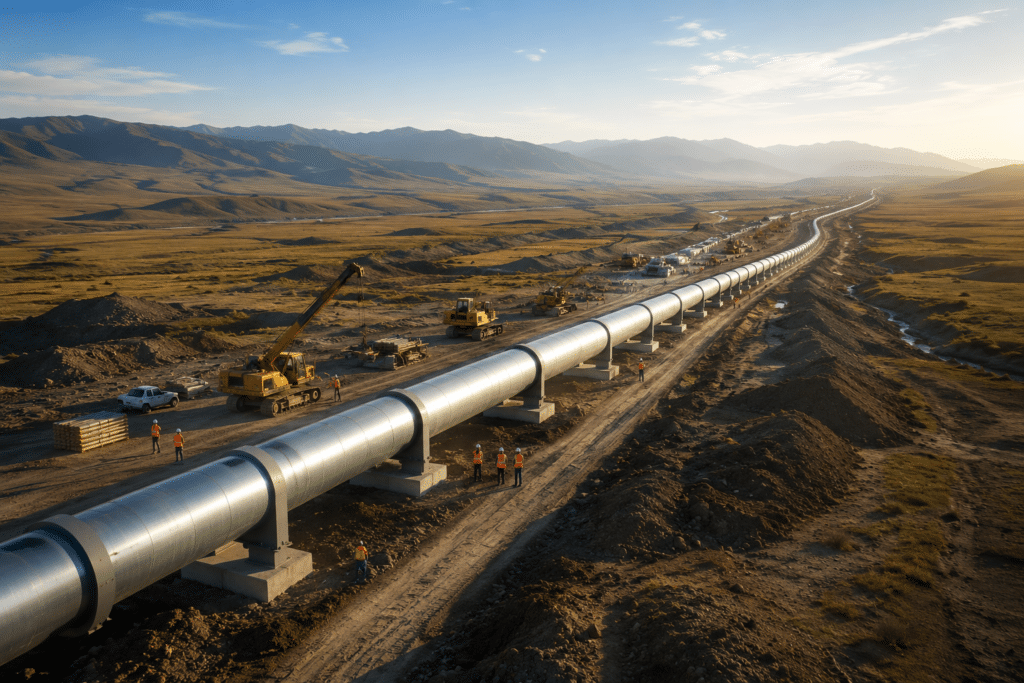
The above-ground configuration introduced particular requirements around pipeline supports, structural interfaces, changes in elevation, expansion and movement, crossings and the relationship between the pipeline and surrounding infrastructure.
These considerations needed to develop alongside process and hydraulic requirements.
Asteria International maintained oversight of the interfaces between pipeline development and the wider FEED, ensuring that route and engineering decisions were considered in terms of their implications for subsequent procurement, construction and operation.
Compressor Infrastructure
The compressor units represented major elements of the overall transmission system.
Their development required coordination across process, mechanical, electrical, instrumentation, controls, civil and structural engineering.
Compressor duties needed to remain aligned with the hydraulic requirements of the pipeline, while the associated infrastructure needed to consider equipment layout, utilities, controls, access, maintenance and operational requirements.
Major rotating equipment also introduced important considerations around equipment procurement and delivery.
Technical definition therefore needed to progress sufficiently during FEED to support subsequent procurement strategy and provide greater certainty around the requirements of the EPC phase.
Asteria International coordinated these interfaces as part of the wider engineering-management role rather than treating the compressor packages as standalone equipment developments.
Engineering for Constructability
FEED needed to establish more than the technical design parameters of the proposed infrastructure.
The developing solution ultimately needed to be capable of being procured, constructed, commissioned, operated and maintained.
Constructability was therefore considered alongside engineering development, particularly given the geographical extent of the infrastructure and the conditions associated with its location.
Construction access, logistics, installation methodology, sequencing, equipment transportation, temporary works and the practical implications of delivering an extensive pipeline system all had the potential to influence engineering decisions.
The above-ground nature of the pipeline also created extensive civil and structural interfaces that needed to be understood as the design developed.
Considering these issues during FEED provided the opportunity to identify constraints while sufficient flexibility remained to influence the engineering solution.
Engineering Management & Technical Assurance
Asteria International maintained oversight of engineering maturity and technical deliverables across the multidisciplinary FEED.
Specialist engineering remained the responsibility of the appropriate engineering disciplines and technical organisations.
Asteria International’s engineering-management role focused on coordination across these disciplines and maintaining alignment between technical development and project objectives, schedule, risk, constructability and subsequent EPC requirements.
Design reviews provided opportunities to challenge assumptions, identify interface issues and assess whether the developing engineering solution provided sufficient definition for subsequent project decisions.
Technical assurance therefore focused not simply on whether individual documents had been produced, but whether the collective engineering definition was developing into a coordinated and executable project.
Design Safety, Operability & Maintainability
Safety, operability and maintainability formed important considerations within the developing engineering definition.
The pipeline and compressor infrastructure needed to be capable not only of meeting the required technical performance but of being constructed, operated, inspected and maintained within the conditions associated with the project environment.
Pipeline routing, equipment layout, access, isolation requirements, maintenance needs, control philosophy and the interaction between major systems therefore needed to be considered as the engineering developed.
These considerations were incorporated through the multidisciplinary engineering and design-review process alongside technical performance, constructability and project risk.
Addressing these requirements during FEED provided the opportunity to influence the engineering solution before progression into the more committed EPC phase.
Design Maturity & Technical Deliverables
Managing design maturity was fundamental to establishing a robust basis for EPC delivery.
Completion of individual FEED documents did not necessarily mean that the underlying design had reached the maturity required for the next project phase.
Asteria International maintained oversight of technical deliverables and their dependencies, considering whether key engineering decisions had been resolved and whether interfaces between disciplines were sufficiently developed.
Outstanding assumptions, technical queries and developing information needed to remain visible within the wider project.
The relationship between individual deliverables was particularly important.
A document could be complete in isolation while remaining dependent upon information or decisions originating elsewhere within the engineering.
Maintaining visibility of these dependencies provided a clearer understanding of actual engineering maturity and reduced the risk of unresolved FEED issues being transferred into EPC execution.
Project Controls & FEED Performance
The multidisciplinary nature of the FEED created significant dependencies between engineering activities and technical deliverables.
Pipeline engineering, compressor development, process design, civil and structural requirements, electrical systems, instrumentation and controls could not progress entirely independently.
Asteria International maintained oversight of project schedule, engineering progress, key interfaces and technical deliverables to provide visibility of the overall FEED position.
Project controls supported identification of emerging constraints and allowed their potential consequences for subsequent engineering, procurement and execution activities to be understood.
Importantly, progress needed to be considered alongside engineering maturity.
Completion percentages alone could not provide a complete understanding of the FEED position if key technical decisions, interfaces or dependencies remained unresolved.
Project controls therefore supported both progress management and a more informed assessment of readiness for the subsequent project phase.
Procurement & Long-Lead Equipment
Major compressor systems and associated infrastructure required procurement considerations to be incorporated into project development.
Long-lead equipment can significantly influence the execution schedule for major energy infrastructure, making sufficient technical definition during FEED important to support subsequent procurement decisions.
Equipment requirements also created dependencies across process, mechanical, electrical, civil, structural and controls engineering.
Asteria International maintained the interface between engineering development and procurement requirements, ensuring that equipment definition and technical information were considered within the wider project position.
This supported alignment between engineering maturity, long-lead equipment requirements and subsequent EPC execution without extending the appointment into a separate Commercial Management service.
Risk & Opportunity Management
Risk and opportunity management formed an integral part of FEED development.
Technical uncertainty, engineering interfaces, equipment requirements, constructability, logistics, environmental conditions, procurement and future EPC execution all presented potential risks to successful project delivery.
The geographical and logistical conditions associated with the project location also needed to be considered within engineering development and execution planning.
Asteria International maintained visibility of these risks alongside engineering development, project controls and design maturity, allowing emerging issues to be considered while there remained an opportunity to influence the technical solution.
Potential opportunities associated with engineering development, construction methodology, procurement strategy, sequencing and execution could similarly be considered before the project moved into a more committed delivery phase.
This is one of the principal values of effective FEED management: reducing uncertainty before it becomes committed cost, construction delay or operational constraint.
Technical Change Management
Changes during FEED could have consequences extending across multiple engineering disciplines.
A change to pipeline requirements could influence compressor duties. Changes to equipment requirements could affect electrical infrastructure, civil and structural design, controls, layout and procurement considerations.
Technical change therefore needed to be considered in terms of its wider project consequences rather than solely within the discipline in which it originated.
Asteria International maintained visibility of developing technical changes and their interfaces across the multidisciplinary FEED.
This supported coordination between affected disciplines and helped ensure that consequential impacts were understood as the engineering definition developed.
Preparing for EPC Delivery
The purpose of FEED was to establish sufficient technical and project definition to provide a robust basis for subsequent EPC delivery.
Engineering maturity, multidisciplinary interfaces, constructability, procurement considerations, project risk and outstanding technical decisions all contributed to determining readiness for the next project phase.
Asteria International maintained oversight of these elements through the project and engineering management appointment, ensuring that completion of individual deliverables was considered alongside the maturity and integration of the overall engineering definition.
Particular attention was given to interfaces between the pipeline, compressor infrastructure, process and mechanical systems, civil and structural requirements, electrical infrastructure, instrumentation and controls.
Long-lead equipment requirements, construction methodology, logistics and unresolved technical matters also needed to remain visible as the FEED progressed towards completion.
The objective was to establish a sufficiently developed technical baseline from which subsequent EPC activities could proceed with greater clarity around scope, interfaces, constraints and project risk.
Senior FEED Project & Engineering Management
Complex energy infrastructure requires strong integration during the front-end stages of project development.
Pipeline hydraulics influence compressor requirements. Compressor systems create mechanical, electrical, controls and utility interfaces. Route development influences civil and structural engineering, logistics and construction methodology, while procurement requirements can influence the sequence and timing of technical decisions.
Managing these relationships during FEED provides an opportunity to resolve uncertainty before engineering decisions become committed procurement or construction constraints.
Asteria International provided Project Management and Engineering Management across these multidisciplinary interfaces, maintaining visibility of engineering maturity, project controls, risk, constructability and EPC readiness throughout the FEED project.
The focus remained on developing a coordinated and sufficiently mature engineering definition capable of supporting the subsequent phase of project delivery.
Complex Projects. Controlled Delivery.
Asteria International provides experienced project and engineering leadership across complex energy, industrial and infrastructure projects.
From concept and FEED through procurement, construction, commissioning and operation, our wider capabilities bring together Project Management, Engineering Management, Commercial Management, Construction Management and Project Controls & Risk Management to support safe, controlled and effective project delivery and operation.