Why successful heat decarbonisation begins with engineering evaluation, not equipment selection
Introduction
Replacing steam heating systems with low-temperature hot water (LTHW) infrastructure is increasingly central to the decarbonisation of hospitals, industrial facilities, universities and other large operational estates.
At first glance, the engineering objective appears relatively straightforward: replace ageing steam boilers and distribution networks with modern hot water systems, integrate heat pump technology and reduce reliance on fossil fuels.
In practice, the transition is considerably more complex.
Steam and hot water behave differently, operate at different temperatures and pressures, and impose fundamentally different requirements upon distribution infrastructure, heat emitters, pumps, controls and associated plant.
An existing steam network may have been designed decades ago, modified repeatedly and operated under conditions that bear little resemblance to its original design intent.
Introducing low-temperature heating into that environment is therefore not simply an exercise in replacing equipment. It requires a detailed understanding of the existing thermal demands, hydraulic characteristics, operating conditions and physical limitations of the infrastructure.
The critical question is not whether a heat pump can generate sufficient heat. It is whether the entire heating system can accept, distribute and use that heat efficiently, reliably and economically.
This distinction underpins Asteria International’s engineering approach to complex energy infrastructure and decarbonisation programmes.
Before decisions are made about plant capacities, technology selection or capital expenditure, the underlying engineering assumptions must be understood, tested and challenged.
1. The First Engineering Decision: Understanding What Actually Exists
One of the greatest risks in major heating infrastructure projects is designing a new system around assumptions about the existing installation.
Historical drawings may be incomplete. Equipment schedules may no longer reflect installed assets. Building modifications, additional heating loads and operational changes may have altered system performance.
Even where reliable documentation exists, original design capacities do not necessarily represent current demand.
A steam boiler rated at 5 MW does not automatically indicate a continuous 5 MW heating requirement.
The original installation may incorporate substantial allowances for warm-up, standby capacity, simultaneous demand, distribution losses and future expansion.
Designing replacement infrastructure directly against installed boiler capacity can result in oversized heat pumps, unnecessary electrical infrastructure, excessive capital expenditure and inefficient part-load operation.
Establishing the existing thermal baseline
At Asteria International, the starting point for a technically credible feasibility assessment is establishing what can be evidenced about the existing system.
Depending upon the complexity of the installation and the availability of reliable information, the assessment considers:
- Historical gas consumption and available steam-generation data.
- Existing boiler ratings, operating profiles and seasonal utilisation.
- Building heating loads, process requirements and domestic hot water demands.
- Steam distribution temperatures, pressures and condensate-return arrangements.
- Distribution losses, insulation condition and known system inefficiencies.
- Existing heat exchangers, calorifiers, air-handling units and terminal heating equipment.
- Existing pump systems, mechanical plantroom arrangements and controls.
- Planned estate modifications, future demand and operational constraints.
Where suitable metering exists, consumption data can be analysed against external temperature, occupancy and operating patterns to develop a more credible demand profile.
However, energy consumption must be interpreted carefully.
Annual gas consumption is not equivalent to useful annual heat demand. Boiler efficiency, steam distribution losses, condensate recovery and other system characteristics must be accounted for.
Similarly, annual energy consumption alone cannot establish peak thermal demand without additional information, justified assumptions or appropriate modelling.
Where uncertainty remains significant, temporary metering, representative load monitoring, physical surveys and engineering modelling may be necessary.
A credible feasibility study must distinguish between measured performance, calculated demand and assumptions requiring further verification.
That distinction is fundamental when determining whether the proposed solution is technically and commercially justified.
2. Why Steam-to-LTHW Conversion Changes the Engineering Problem
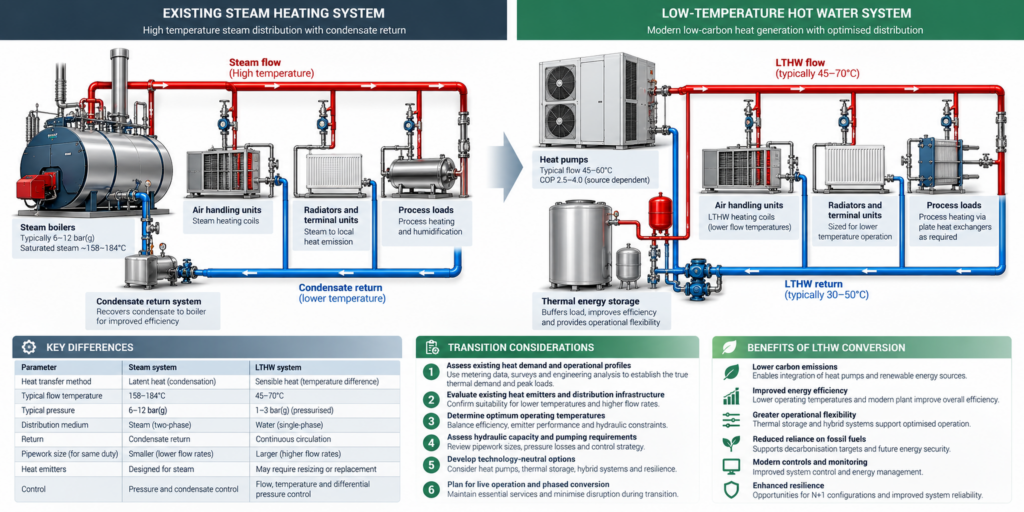
Steam systems transfer substantial thermal energy through condensation at the point of use.
LTHW systems transfer sensible heat through the controlled circulation of water.
Although both systems deliver thermal energy, their distribution characteristics are fundamentally different.
In a steam network, heat transfer is largely associated with the latent heat released when steam condenses, although sensible heat contributions may also be relevant.
In an LTHW network, the energy transferred depends on circulating mass flow, specific heat capacity and the temperature difference between flow and return.culating mass flow, specific heat capacity and the temperature difference between flow and return.
For water operating over a relatively limited temperature range, the basic relationship is:
Q̇ = ṁ × cp × ΔT
Where:
- Q̇ = thermal power transferred (kW).
- ṁ = mass flow rate (kg/s).
- cp = specific heat capacity of water (kJ/kg·K).
- ΔT = flow and return temperature difference (K).
This relationship has significant implications for the design of replacement heating infrastructure.
Worked example: 1.4 MW heating duty
Consider a proposed LTHW system required to transfer 1,400 kW.
Using an approximate specific heat capacity of 4.18 kJ/kg·K:
At a 20 K design temperature differential:
Mass flow = 1,400 / (4.18 × 20)
Mass flow ≈ 16.75 kg/s
Using an approximate water density of 1,000 kg/m³, this is equivalent to approximately 60.3 m³/h.
At a 10 K design temperature differential:
Mass flow = 1,400 / (4.18 × 10)
Mass flow ≈ 33.49 kg/s
Using the same approximate density, this is equivalent to approximately 120.6 m³/h.
| Parameter | 20 K differential | 10 K differential |
|---|---|---|
| Thermal duty | 1,400 kW | 1,400 kW |
| Mass flow | 16.75 kg/s | 33.49 kg/s |
| Approximate volume flow | 60.3 m³/h | 120.6 m³/h |
| Relative flow requirement | 100% | 200% |
Illustrative engineering calculation using constant approximate water properties. Actual design calculations should use fluid properties at the relevant operating temperatures.
Halving the design temperature differential doubles the required mass flow for the same thermal output, assuming constant specific heat capacity.
If pipe diameters remain unchanged, this also approximately doubles flow velocity and can substantially increase frictional pressure losses.
For fully developed turbulent flow, pressure loss may increase approximately with the square of velocity where friction factors remain broadly comparable. The precise increase depends upon Reynolds number, pipe roughness, friction factor and system geometry.
This creates immediate consequences for:
- Distribution pipework capacity.
- Pump selection and electrical demand.
- Control valve performance.
- Hydraulic balancing.
- Noise, vibration and system stability.
- Plantroom arrangements and installation constraints.
The increase in flow does not, by itself, establish the increase in electrical pumping power. Pump input depends upon the complete hydraulic system resistance, operating duty and pump efficiency.
Nevertheless, a temperature decision made during feasibility can determine whether existing distribution infrastructure can be retained or requires substantial replacement.
The commercial difference between those outcomes may be considerable.
[INSERT GRAPHIC 2: Steam-to-LTHW Technical Engineering Comparison Diagram]
3. Evaluating Whether Existing Heating Infrastructure Is Suitable
One of the most important upfront evaluations is establishing whether existing terminal equipment can deliver the required heating duty at lower water temperatures.
Legacy systems may have been designed around high-temperature steam or high-temperature hot water.
Reducing the supply temperature reduces the temperature difference available to transfer heat into occupied spaces or processes.
That can reduce the output of radiators, heating coils, air-handling units and other heat emitters.
A system that performs adequately at its historic operating temperature may be unable to achieve the same performance at 60°C, 55°C or lower.
Assessing heat exchanger and heating coil performance
For a heat exchanger operating under appropriate steady-state conditions, a simplified design relationship is:
Q̇ = U × A × ΔTlm
Where:
- U = overall heat transfer coefficient (W/m²·K).
- A = effective heat transfer area (m²).
- ΔTlm = logarithmic mean temperature difference (K).
Where necessary, a configuration correction factor must also be applied to account for exchanger geometry and flow arrangement.
The relationship illustrates an essential engineering constraint.
As the available temperature difference decreases, maintaining the same duty may require increased effective heat transfer area, improved heat transfer characteristics or changes to the operating configuration.
However, overall heat transfer coefficients also depend upon fluid properties, flow regimes and equipment construction. A detailed appraisal therefore requires actual equipment data rather than a simplified temperature comparison alone.
The Asteria evaluation approach
At feasibility stage, Asteria’s engineering assessment and technical assurance approach considers the available design and operational evidence to determine:
- Which existing heating assets can operate satisfactorily at proposed temperatures.
- Which items require further testing or manufacturer verification.
- Which equipment may require replacement or modification.
- Whether some loads require higher-temperature secondary circuits.
- Whether the proposed temperature regime can satisfy winter design conditions.
- Whether phased conversion is technically and operationally achievable.
The outcome may not be a single temperature solution for the entire estate.
A more appropriate arrangement could combine low-temperature heating for general building services with separately controlled higher-temperature requirements for particular processes or specialist equipment.
That decision should emerge from technical assessment, not from an assumption that every existing load can accept the same temperature regime.
4. Heat Pump Selection Must Follow System Evaluation
Heat pumps offer an important opportunity to reduce fossil-fuel consumption, but their effectiveness is closely linked to the temperatures at which they operate.
For a given source temperature, increasing the required heating delivery temperature generally reduces heat pump efficiency because the required temperature lift increases.
The coefficient of performance (COP) is defined as:
COP = Useful heat output / Electrical power input
For example, a heat pump delivering 1,400 kW of thermal output at a COP of 3.5 would require approximately:
Electrical input = 1,400 / 3.5 = 400 kW
At a COP of 2.5:
Electrical input = 1,400 / 2.5 = 560 kW
This represents an additional electrical input of 160 kW for the same thermal output.
| Parameter | COP 3.5 | COP 2.5 |
|---|---|---|
| Thermal output | 1,400 kW | 1,400 kW |
| Heat pump electrical input | 400 kW | 560 kW |
| Additional electrical input | — | 160 kW |
Illustrative operating-point comparison. Values do not represent a specific manufacturer’s equipment or complete system electrical demand.
The calculation demonstrates why nominal manufacturer COP figures should not be treated as representative of annual system performance.
Seasonal assessment must consider operating temperatures, ambient conditions, part-load operation, defrost where applicable, controls and auxiliary electrical consumption.
The system seasonal performance factor may differ from the heat pump’s rated COP because the defined assessment boundary can include additional electrical loads and operating conditions.
Technology-neutral feasibility
Asteria International’s independent engineering approach evaluates technologies against the requirements of the facility rather than allowing equipment selection to define the project.
Depending on site conditions, the options assessment may include:
- Ground source heat pumps.
- Air source heat pumps.
- Water source heat pumps.
- Heat recovery systems.
- Hybrid heat pump and boiler configurations.
- Thermal energy storage.
- Electrical infrastructure upgrades.
- Demand reduction and distribution improvements.
Ground source installations may provide relatively stable source temperatures, but require assessment of ground conditions, borehole capacity, thermal interference and long-term ground performance.
Air source systems require assessment of low-ambient-temperature performance, defrost, acoustics, plant location and electrical infrastructure.
Water source systems depend upon source availability, temperature, water quality, abstraction and discharge requirements, and associated environmental constraints.
The lowest equipment purchase price does not necessarily represent the best engineering or whole-life solution.
A robust appraisal must consider annual energy consumption, maintenance, availability, replacement requirements, carbon performance and long-term operating expenditure.
5. Hydraulic Design: The Risk Hidden Within Low-Temperature Systems
The hydraulic consequences of converting steam distribution to LTHW are frequently underestimated.
A steam distribution network cannot simply be reused as a pumped hot-water network without detailed engineering verification.
LTHW systems require continuous liquid circulation and must account for:
- Static and dynamic pressure.
- Pipework pressure losses.
- Pump duty and control philosophy.
- Pressurisation and expansion.
- Air removal and water quality.
- Hydraulic separation.
- Control valve authority.
- Minimum flow requirements.
- Differential pressure management.
Existing site constraints can introduce additional complexity.
Long distribution routes, multiple plantrooms, differing building elevations and changing operational loads may produce hydraulic characteristics that are difficult to predict from drawings alone.
Why differential pressure matters
The frictional pressure loss along a straight pipe can be represented by the Darcy–Weisbach equation:
Δp = f × (L/D) × (ρv²/2)
Where:
- Δp = frictional pressure loss (Pa).
- f = Darcy friction factor (dimensionless).
- L = pipe length (m).
- D = internal pipe diameter (m).
- ρ = fluid density (kg/m³).
- v = average fluid velocity (m/s).
This relationship demonstrates the sensitivity of hydraulic losses to flow velocity and pipe dimensions.
However, the equation represents straight-pipe frictional losses. A complete system assessment must also account for fittings, valves, strainers, heat exchangers and other local resistance losses.
The required pump duty must reflect the relevant hydraulic circuit, operating conditions and control strategy.
A distribution system that is hydraulically acceptable at one operating condition may become inefficient or unstable when flow requirements change.
Evaluating existing pipework
An upfront assessment should therefore examine not only nominal pipe size but also internal condition, material suitability, pressure ratings, thermal expansion, available routes and the complete hydraulic network.
Where existing distribution infrastructure cannot accommodate the required flows, alternatives may include:
- Increasing pipework capacity.
- Introducing local hydraulic separation.
- Revising design temperature differentials.
- Dividing the distribution into independently controlled zones.
- Locating heat generation closer to significant loads.
- Using alternative plant configurations.
Each option presents different capital, operational and programme consequences.
This is why hydraulic evaluation must form part of early feasibility rather than being left until detailed design.
6. Thermal Energy Storage: More Than a Buffer Vessel
Thermal energy storage can provide significant operational flexibility within low-carbon heating systems.
However, the purpose of the storage must be clearly defined.
A buffer vessel designed to maintain minimum heat pump run times is not necessarily equivalent to a thermal energy store intended to support peak demand, load shifting or resilience.
The theoretical sensible heat stored across a specified temperature change can be approximated by:
E = ρ × V × cp × ΔT
Where:
- E = thermal energy (kJ, when consistent units are used).
- ρ = water density (kg/m³).
- V = storage volume (m³).
- cp = specific heat capacity (kJ/kg·K).
- ΔT = assumed usable temperature difference (K).
Worked example: 70 m³ thermal store
Assume a water storage volume of 70 m³ and an available temperature difference of 20 K.
Using an approximate density of 1,000 kg/m³ and specific heat capacity of 4.18 kJ/kg·K:
E = 1,000 × 70 × 4.18 × 20
E = 5,852,000 kJ
Converting to kilowatt-hours:
E = 5,852,000 / 3,600
E ≈ 1,625.6 kWh, or 1.63 MWh
At a constant thermal demand of 1 MW:
Theoretical discharge duration = 1.6256 / 1
Duration ≈ 1.63 hours
The calculation represents the theoretical sensible heat available across the specified 20 K temperature range.
It does not guarantee that 1 MW of useful heat can be delivered continuously for 1.63 hours.
Actual available duty and discharge duration depend upon tank stratification, mixing, standing heat losses, discharge flow, heat exchanger characteristics and the minimum acceptable system supply temperature.
The charging and discharging arrangement may also constrain the usable storage capacity.
A thermal store must therefore be assessed in terms of its deliverable energy and useful operating characteristics, not simply its physical volume.
The engineering questions
Before establishing a storage capacity, the feasibility process should determine:
- What operational function the store must provide.
- The required charging and discharging rates.
- Whether it supports peak-load management or heat pump cycling.
- How storage temperatures influence heat pump performance.
- The impact of mixing and stratification.
- How the system responds to equipment failure.
- Whether storage operation offers genuine economic or carbon benefits.
Storage should be justified by a defined operational requirement and supporting analysis.
An oversized vessel adds cost, heat loss, space requirements and potential control complexity without necessarily improving performance.
7. Engineering Resilience in Live Operational Environments
For hospitals, pharmaceutical facilities, manufacturing plants and critical infrastructure, continuity of energy supply can be as important as the decarbonisation objective.
The engineering assessment must consider both the final operating arrangement and the transition required to reach it.
A proposed system may satisfy the calculated design duty but still present unacceptable risk if failure of a common electrical supply, control system, pump or hydraulic header compromises the entire installation.
Understanding the meaning of redundancy
Installing two boilers or two heat pumps does not automatically establish N+1 resilience.
Genuine resilience depends upon the capacity and independence of the complete system.
The assessment should consider:
- Duty and standby generation capacity.
- Common electrical and control dependencies.
- Pump and distribution redundancy.
- Failure modes and single points of failure.
- Equipment availability during maintenance.
- Winter peak-demand conditions.
- Temporary operating arrangements.
- Recovery following loss of power or plant failure.
For a correctly defined N+1 arrangement, sufficient capacity must remain available to satisfy the specified duty following the loss of one relevant capacity unit.
Whether that means full design demand or a specified critical demand must be explicitly established.
Common dependencies and potential common-cause failures must also be evaluated.
The challenge of live conversion
Replacing steam infrastructure within an operational estate introduces additional risks associated with isolation, temporary heating and the sequencing of modifications.
A technically satisfactory final design is of limited value if the existing services cannot be safely maintained during construction.
This makes early consideration of phased construction, temporary services and operational interfaces an essential part of engineering feasibility.
The proposed transition sequence should be examined before capital commitments are made to major plant and infrastructure.
8. How Asteria International Approaches Upfront Engineering Evaluations
At Asteria International, engineering feasibility is approached as a structured decision-making process that brings together technical performance, operational requirements, commercial viability and project risk.
The objective is to establish sufficient confidence in the proposed solution before significant investment decisions are made.
Rather than beginning with a preferred equipment package, the evaluation progresses from understanding the existing asset through to testing technically credible options.
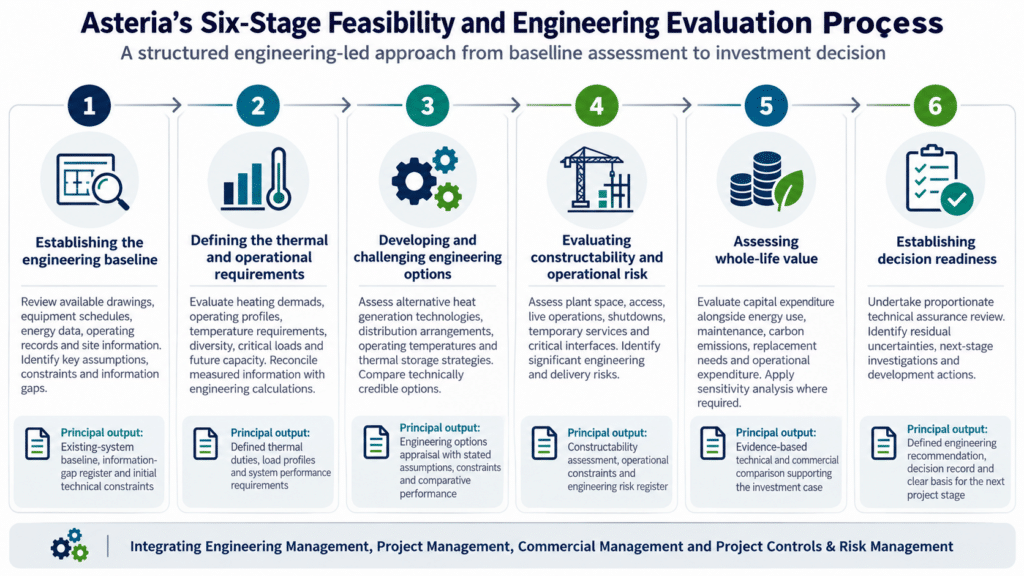
Stage 1 — Establishing the engineering baseline
Available drawings, equipment schedules, energy data, operating records and site information are reviewed to establish the existing condition.
Key assumptions and information gaps are identified, and proportionate site surveys or further investigations are recommended where required.
Principal output: Existing-system baseline, information-gap register and initial technical constraints.
Stage 2 — Defining the thermal and operational requirements
Heating demands, operating profiles, temperature requirements, diversity, critical loads and future capacity are evaluated.
Measured information is reconciled with engineering calculations and operational requirements.
Principal output: Defined thermal duties, load profiles and system performance requirements.
Stage 3 — Developing and challenging engineering options
Alternative heat generation technologies, distribution arrangements, operating temperatures and thermal storage strategies are assessed.
The evaluation considers the interaction between thermal performance, hydraulic requirements, electrical capacity and existing infrastructure.
Options are screened for technical feasibility and developed to a level appropriate for meaningful comparison.
Principal output: Engineering options appraisal with stated assumptions, constraints and comparative performance.
Stage 4 — Evaluating constructability and operational risk
Proposed solutions are assessed against site access, available plant space, existing utilities, live operations, planned shutdowns and temporary service requirements.
Engineering risks and significant interfaces are identified before the design progresses.
Principal output: Constructability assessment, operational constraints and engineering risk register.
Stage 5 — Assessing whole-life value
Capital expenditure is evaluated alongside projected energy consumption, maintenance, plant replacement, carbon emissions and operational expenditure.
Sensitivity analysis can be applied to significant variables such as electricity prices, gas prices, seasonal heat pump efficiency and future heat demand.
Principal output: Evidence-based technical and commercial comparison supporting the investment case.
Stage 6 — Establishing decision readiness
The preferred option is subjected to a proportionate technical assurance review.
Residual uncertainties, required investigations, critical interfaces and design-development actions are identified.
The resulting recommendations support progression into the appropriate business case, concept design or Front-End Engineering Design (FEED) stage.
Principal output: A defined engineering recommendation, decision record and clear basis for the next project stage.
This approach integrates Asteria’s Engineering Management, Project Management, Commercial Management and Project Controls & Risk Management capabilities.
It is intended to ensure that technical decisions are made with a clear understanding of their impact upon project cost, programme, risk and long-term asset performance.
9. Why Upfront Engineering Can Protect the Investment Case
Heat decarbonisation projects can involve substantial expenditure on thermal generation, electrical infrastructure, distribution networks, building modifications and associated enabling works.
Early engineering decisions consequently have a disproportionate influence on project cost and long-term performance.
An incorrect heating-load assumption may lead to unnecessary plant capacity.
An unverified temperature assumption may necessitate late replacement of heat exchangers or terminal equipment.
An inadequate hydraulic assessment may result in excessive pumping energy or expensive distribution modifications.
An incomplete understanding of electrical infrastructure may reveal significant additional investment requirements after preferred equipment has already been selected.
These issues are not simply detailed-design problems.
They can fundamentally change the viability of the business case.
Consider two technically feasible solutions:
Option A offers lower initial plant expenditure but requires significant network modifications, operates at a higher temperature and has greater expected electricity consumption.
Option B involves greater initial investment in distribution optimisation and heat-emitter improvements but enables lower operating temperatures and potentially improved seasonal efficiency.
Selecting between them requires a whole-life assessment rather than comparison of equipment capital costs alone.
Net present value, discounted cash flow, operating costs, carbon emissions, operational resilience and future asset requirements may all influence the outcome.
The preferred option should be the one that demonstrably best satisfies the client’s defined technical, operational, financial and environmental objectives.
Effective feasibility does not simply demonstrate that a proposed solution can work. It establishes whether it is the right solution to invest in.
10. From Engineering Evaluation to Project Delivery
The findings of an upfront assessment must remain connected to the subsequent engineering and construction process.
Initial assumptions concerning heat loads, operating temperatures, hydraulic capacity and electrical demand should become controlled design requirements.
As design information develops, those assumptions should be progressively verified.
Where material changes arise, their implications for equipment capacity, commercial commitments, programme and operational performance must be assessed.
This is particularly important where specialist heat pump suppliers, mechanical contractors, electrical infrastructure providers and existing estate operators contribute to different parts of the overall installation.
Without effective technical governance, individual packages can develop around incompatible assumptions.
Asteria International’s integrated engineering and project delivery approach connects these interfaces through multidisciplinary design coordination, technical reviews, engineering change control and project risk management.
The purpose is to maintain a clear relationship between the original investment objectives, the engineering solution being developed and the operational performance ultimately required.
Conclusion
The transition from steam heating to low-temperature hot water represents considerably more than a change in heat generation technology.
It requires a fundamental reassessment of how thermal energy is generated, distributed, controlled and consumed.
System temperatures influence heat pump efficiency. Temperature differentials determine circulation rates. Circulation rates influence pipework capacity, pressure losses and pumping demand. Existing heat emitters determine whether lower temperatures can deliver the required heating duty.
These factors are technically interconnected, and each can influence the capital and operational economics of the project.
Successful decarbonisation therefore depends upon examining the complete energy system rather than considering heat generation in isolation.
For complex operational estates, that examination must also account for resilience, maintainability, phased construction and continuity of essential services.
At Asteria International, we believe the greatest value of engineering involvement often comes before equipment is purchased or construction begins.
Independent feasibility assessment, disciplined technical evaluation and the challenge of underlying assumptions provide the foundation for informed investment decisions.
The objective is not simply to replace an existing steam system with a lower-carbon alternative.
It is to develop an energy infrastructure solution that is technically sound, economically justified, operationally resilient and capable of delivering measurable long-term performance.
About Asteria International
Asteria International Limited provides independent engineering, project, construction and commercial management services supporting complex capital projects across healthcare, energy, industrial manufacturing, infrastructure and other technically demanding sectors.
Our services include feasibility and engineering strategy, multidisciplinary engineering management, technical assurance, project management, construction management, commercial management and project controls.
We support clients from early-stage option evaluation and business case development through engineering, procurement, construction and operational handover.
Explore our services:
- Engineering Management
- Project Management
- Construction Management
- Commercial Management
- Project Controls & Risk Management
Website: www.asteria-international.com
References and Further Reading
[1] Chartered Institution of Building Services Engineers (CIBSE), 2022. AM17: Heat Pump Installations for Large Non-Domestic Buildings, including subsequent corrigenda. CIBSE Knowledge Portal.
[2] CIBSE, 2021. Design Guide: Heat Networks. CIBSE Knowledge Portal.
[3] CIBSE and Association for Decentralised Energy, 2020. CP1: Heat Networks — Code of Practice for the UK.
[4] CIBSE Journal, 2024. Module 231: Foundations for Successful Heat Pump Installations in Non-Domestic Buildings. Read technical article.
[5] CIBSE, Principles of Hydraulics and Control of Modern Heat Networks. Technical training overview.
Technical note: Numerical examples are illustrative engineering calculations and are not representations of measured performance from a specific Asteria International project. Project-specific engineering must be based upon verified design conditions, appropriate standards, equipment data and detailed technical assessment.