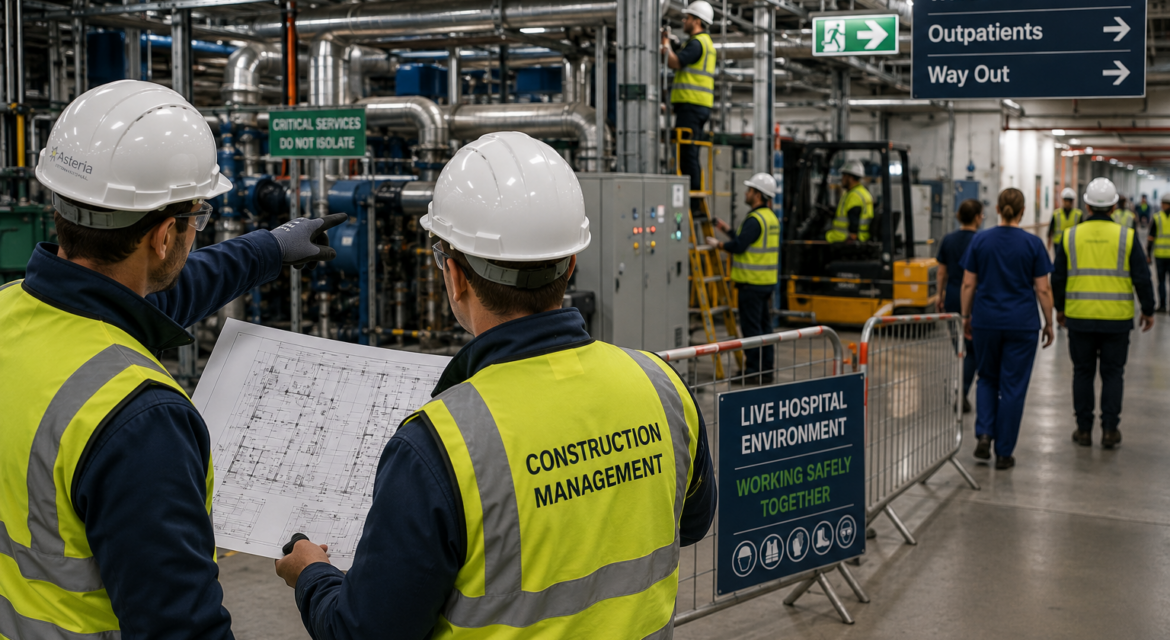
Construction & Commissioning in Live Operational Environments: Managing the Transition Without Disrupting Operations
Construction within a live hospital or manufacturing facility is fundamentally different from construction on an empty site.
The physical work may be similar, but the environment in which it has to be delivered is not.
Hospitals still need to treat patients. Heating, power, ventilation, water and other critical services need to remain available. Manufacturing facilities need to maintain production, process conditions, utilities and safety-critical systems while modifications take place around them.
In these environments, the project does not have exclusive control of the site.
The existing operation has its own people, equipment, access requirements, maintenance activities, safety procedures and priorities. Construction and commissioning have to work around them.
That changes the way the project needs to be planned and managed.
A programme that makes sense from a purely construction perspective may be unacceptable operationally. An isolation that appears straightforward on a drawing may affect equipment well beyond the immediate work area. A temporary arrangement may become critical to maintaining the facility. A new system may be physically complete but still not be sufficiently commissioned or proven to replace the infrastructure already in service.
For the project team, the challenge is therefore not simply to complete the new works.
It is to move the facility from its existing operating condition to its future operating condition in a controlled manner, while protecting the operation throughout that transition.
That requires construction management, engineering, operations, specialist contractors and commissioning to work as an integrated team.
The Operation Is Part of the Construction Environment
On a new-build site, construction activities can largely determine how the site develops.
A live hospital or manufacturing facility is different.
The existing operation establishes constraints before construction begins.
These can include:
- critical electrical, heating, cooling and ventilation systems;
- process and production utilities;
- operational access routes;
- restricted working areas;
- clinical or production activities;
- hygiene and contamination controls;
- fire and life-safety systems;
- security requirements;
- emergency access;
- planned maintenance;
- production or clinical schedules; and
- limited opportunities for shutdowns and isolations.
These are not secondary considerations to be dealt with once construction starts.
They form part of the construction environment and should influence the delivery strategy from the outset.
HSE guidance recognises this distinction. Where construction takes place in or near occupied premises, including hospitals and factories, the client and construction team need to consider the nature of the premises, who may be exposed, the nature of the work and the risks created for occupants. Where premises remain occupied, the adequacy of precautions should continue to be reviewed as the work progresses.[1]
Before deciding how something will be built, the project therefore needs to understand what must continue to function while it is being built.
Construction Strategy Needs to Be Developed Collectively
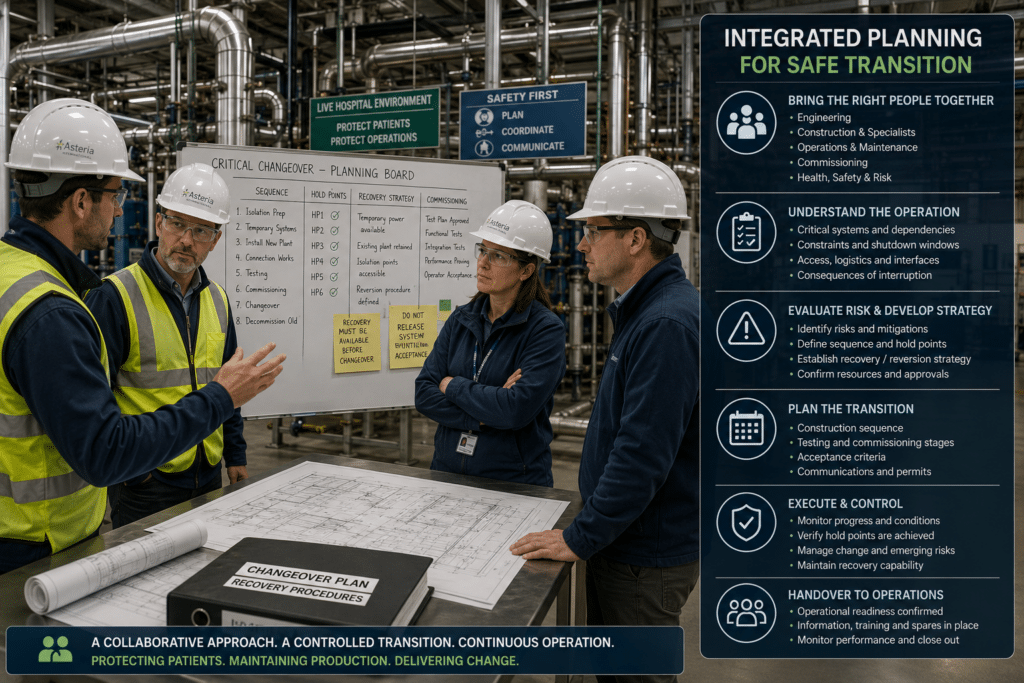
A credible construction and commissioning strategy cannot usually be developed by one person or organisation working in isolation.
Different parties hold different pieces of the information needed to make the strategy work.
The principal contractor and specialist contractors understand installation methodology and practical sequencing. Engineering teams understand the design, technical dependencies and system interfaces. Operations and maintenance teams understand the existing facility and the consequences of interrupting services.
Health and safety specialists understand the hazards and necessary controls. Suppliers bring detailed knowledge of specialist equipment. Commissioning specialists understand what needs to be tested, integrated and proven before the new infrastructure can safely enter service.
Construction management needs to bring that knowledge together.
Before the detailed programme is fixed, the relevant parties should collectively work through how the project will actually be delivered.
Depending on the work, this may involve the Construction Manager, Project Manager, engineering disciplines, principal contractor, specialist contractors, equipment suppliers, operations, maintenance, health and safety and commissioning personnel.
The purpose is not simply to obtain agreement to a programme that has already been prepared.
It is to formulate the delivery strategy using the collective knowledge available to the project.
The team should be asking:
- What is the most practical sequence for carrying out the work?
- Which existing systems constrain that sequence?
- Which services must remain operational?
- Which contractors need to work together or in a particular order?
- Where are the critical interfaces between packages?
- What enabling works are required?
- What temporary arrangements are needed?
- Which isolations and shutdowns will be required?
- What are the principal construction and operational risks?
- What access, lifting, logistics or space constraints exist?
- What engineering information is still required?
- How will the new systems be tested and commissioned?
- What needs to be proven before the project moves to the next stage?
- How will the operation be protected if the planned sequence cannot be completed?
These discussions allow assumptions to be challenged before they become embedded in the programme.
A contractor may identify a better installation sequence. An operator may identify a dependency that is not apparent from the drawings. Engineering may identify a technical constraint. The commissioning team may identify additional testing required before a changeover can safely occur.
The value comes from having the people with the relevant knowledge involved while the strategy can still be changed.
Risk Should Shape the Strategy and Programme
Construction planning in a live environment cannot be separated from risk management.
A proposed sequence may be technically achievable but create an unacceptable operational risk.
An alternative sequence may take longer or require additional temporary infrastructure but substantially reduce the consequence of something going wrong.
That trade-off needs to be understood.
Risk assessment should therefore inform the construction and commissioning strategy rather than being carried out after the strategy has already been decided.
The team needs to consider not only the probability of an event but its consequence.
An interruption that would be inconvenient on a conventional commercial building could be unacceptable where it affects critical hospital infrastructure or stops an important manufacturing process.
The resulting programme should reflect the risk strategy.
It becomes more than a list of contractor activities. It should contain the logic, dependencies, interfaces, enabling works, temporary arrangements, shutdowns, hold points, testing and commissioning activities required to deliver the change safely.
As conditions change, that strategy needs to be reviewed.
The programme should evolve with the project rather than becoming a fixed document against which an increasingly different reality is reported.
Construction Sequencing Has to Reflect Operational Reality
The most efficient construction sequence is not always the right sequence for a live facility.
Existing infrastructure may need to remain operational until its replacement has been installed, tested and demonstrated to be reliable.
Work may need to move between areas to preserve operational access.
Connections may only be possible during agreed shutdown windows.
Some activities may need to be undertaken outside normal production or clinical periods.
Temporary systems may need to be installed before existing services can be isolated.
This can produce sequences that would make little sense on an unrestricted site but are entirely appropriate in an operational environment.
These requirements need to appear in the programme as genuine dependencies.
If a shutdown can only occur during an agreed weekend, it is a programme constraint.
If an existing system cannot be removed until the replacement has passed defined commissioning tests, that is a programme dependency.
If temporary power has to be installed and proven before an existing electrical supply can be isolated, that is part of the construction sequence.
The programme needs to represent how the work can actually be delivered, not simply how quickly the individual construction activities could theoretically be completed.
Existing Services Cannot Be Treated as Background Information
One of the greatest risks when working within existing facilities is the interaction with live services.
Electrical supplies, heating and cooling systems, water, drainage, compressed air, process utilities, controls, fire systems, communications and specialist services may all pass through or around the construction area.
Drawings provide an important starting point, but existing facilities change.
Equipment is replaced. Services are diverted. Modifications accumulate over many years. Temporary arrangements sometimes become permanent and documentation does not always keep pace with what has happened physically.
Verification therefore matters.
Surveys, tracing, inspections, intrusive investigations where appropriate and engagement with operational and maintenance teams all help establish what is actually present.
The consequence of getting this wrong can extend well beyond the construction area.
An unplanned electrical interruption may affect clinical departments or stop production. An incorrect valve isolation may remove a service from another part of the facility. Interference with controls, alarms or communications can create consequences that are not immediately apparent at the workface.
Construction management therefore needs to understand the relationship between the immediate work and the wider operational system.
Shutdowns and Isolations Are Project Activities
A significant shutdown or isolation should not be treated simply as a date in the programme.
It is a managed project activity in its own right.
Before work starts, the project may need to establish:
- the precise scope of the isolation;
- which systems and users will be affected;
- who has authority to isolate and reinstate;
- what permits and approvals are required;
- what enabling works need to be completed beforehand;
- what condition the system needs to be in before work begins;
- how the modification will be tested;
- what resources and specialist personnel need to be available;
- what happens if the work cannot be completed within the available window;
- how services will be restored; and
- who confirms that the system is safe to return to operation.
Where several contractors and operational teams are involved, those interfaces become particularly important.
HSE guidance on permit-to-work systems identifies construction, alteration and modification among the activities for which formal work controls may be appropriate, particularly where several individuals or groups need to coordinate their activities or responsibility passes between groups.[2]
The programme therefore needs more than an activity labelled “shutdown”.
It needs the preparation, approvals, enabling work, isolation, construction, testing, commissioning and reinstatement activities that make that shutdown achievable.
Critical Changeovers Need a Defined Recovery Strategy
A critical changeover needs more than a forward construction sequence.
The project also needs to understand what happens if that sequence cannot be completed successfully.
This is particularly important in hospitals and manufacturing facilities where loss of power, heating, cooling, ventilation, process utilities, controls or other essential infrastructure can have consequences far beyond the project itself.
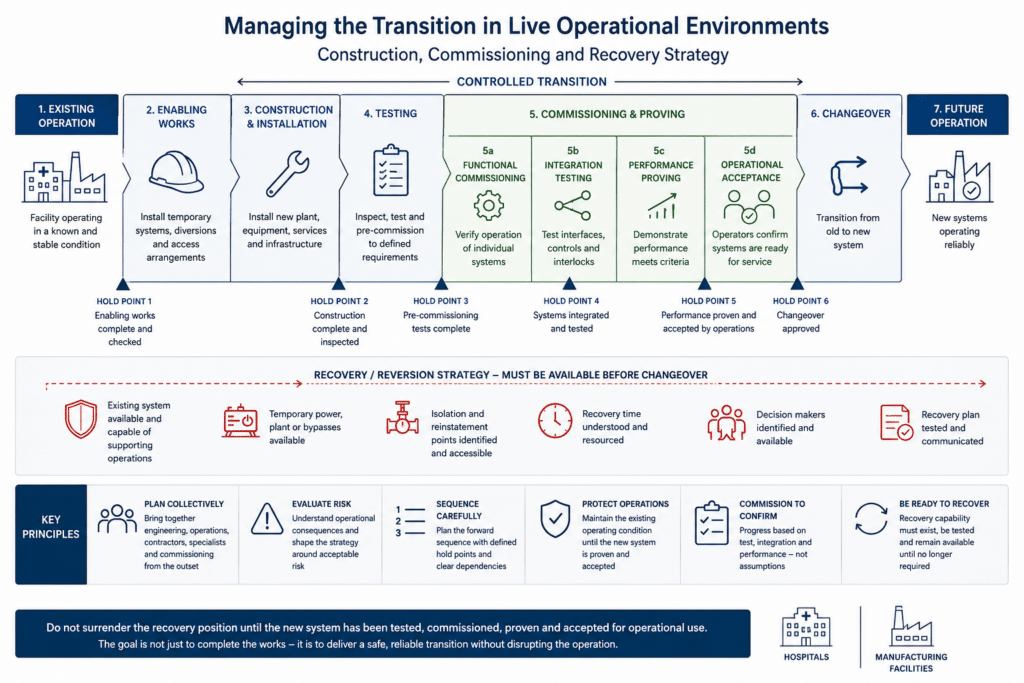
A credible changeover strategy needs both a forward route and an available route to recovery.
Importantly, the recovery position must exist before the changeover work begins.
It is not sufficient to describe theoretically how the facility could be returned to service.
If the project is relying on an existing system, temporary installation, bypass or alternative supply as its recovery position, that arrangement needs to remain physically available and capable of supporting the operation for as long as the strategy depends upon it.
Before a critical changeover begins, the project should therefore establish:
- the existing safe operating condition;
- the proposed construction and changeover sequence;
- the services and operations that could be affected;
- the available recovery or reversion arrangement;
- any temporary plant, supplies, bypasses or resilience measures required;
- the time available within the shutdown window;
- defined hold points within the sequence;
- the testing and commissioning required at each stage;
- the acceptance criteria for progressing beyond each hold point;
- what circumstances would trigger a decision to stop;
- the time required to recover;
- the latest point at which recovery can safely begin;
- the point beyond which returning to the previous configuration is no longer reasonably practicable; and
- who has authority to proceed, hold, recover or accept the new operating condition.
This needs to be understood before the work starts.
There may be a point in the sequence where the project physically removes an existing item of plant, modifies a critical connection or changes the configuration in a way that makes straightforward reinstatement impossible.
That is effectively a point of no return.
It should be identified and deliberately managed.
The project should not cross it simply because the preceding construction activities happened to finish.
Commissioning Determines When It Is Safe to Move Forward
Commissioning is integral to this process.
On a live operational site, commissioning cannot sensibly be treated as an activity that starts after construction has finished.
It forms part of the construction and changeover strategy.
At defined stages, the project needs evidence that the new installation has achieved the condition required to move forward.
Depending on the system, that may include:
- mechanical inspection;
- pressure or integrity testing;
- electrical testing;
- energisation;
- instrumentation checks;
- controls verification;
- alarm and interlock testing;
- functional testing;
- system integration;
- performance proving; and
- operator acceptance.
The precise requirements will vary, but the underlying principle is important.
Progression through a critical changeover should be based on demonstrated condition, not simply completion of a construction activity.
Installing a replacement system does not necessarily justify removing the existing one.
The new system may first need to be energised, commissioned, integrated with controls and demonstrated to operate reliably.
A typical transition might therefore follow:
Existing System Available → New Installation → Inspection & Testing → Energisation → Functional Commissioning → System Integration → Performance Proving → Operational Acceptance → Existing System Released
At each significant stage, the project should understand whether recovery remains possible and what would be required to achieve it.
Eventually, the project will reach a point where it commits to the new configuration and the previous arrangement can no longer reasonably be reinstated.
That should be a planned decision.
The recovery position should not be surrendered until the agreed testing, commissioning and acceptance criteria for doing so have been achieved.
In a hospital, the project cannot afford to discover halfway through a critical changeover that the previous heating or electrical arrangement can no longer be restored while the replacement system has yet to demonstrate reliable operation.
The same principle applies to manufacturing. A viable production configuration should not be unnecessarily surrendered before replacement infrastructure has demonstrated that it can support the process requirements placed upon it.
The purpose is not to assume that the changeover will fail.
It is to ensure that an unexpected construction or commissioning problem does not become an operational failure.
Temporary Arrangements Need Proper Engineering and Control
Maintaining operations during construction frequently requires temporary arrangements.
These might include temporary power, heating, cooling, ventilation, water supplies, process utilities, bypasses, access routes, drainage or control arrangements.
It is easy to regard these as secondary to the permanent works.
They are not.
For the period in which they are operating, a temporary system may be providing a critical service to the hospital or manufacturing facility.
It therefore needs to be appropriately designed, installed, tested, operated and maintained.
Temporary arrangements can also create interfaces of their own. They may introduce different isolation points, alter normal operating procedures or change the way personnel respond to alarms and faults.
Everybody affected needs to understand the temporary operating condition.
This becomes particularly important when temporary arrangements remain in place longer than originally anticipated.
Something intended for several days may remain operational for weeks or months as the wider project changes.
Good construction management treats temporary configurations as controlled operating states, not informal workarounds.
Access and Logistics Become Shared Resources
Construction logistics on an operational site are rarely confined to the construction team.
Roads, corridors, lifts, loading areas, car parks, service yards and entrances may already be heavily used.
Construction then adds deliveries, lifting operations, waste removal, contractor movements and temporary storage.
Planning therefore needs to consider not only whether construction can gain access, but what that access means for the people operating and using the facility.
Large deliveries may require timed arrival slots. Crane operations may temporarily restrict roads. Materials may need to arrive in smaller quantities because storage space is limited. Waste movements may need to avoid periods of high operational activity.
Segregation can be equally important.
Within hospitals, construction personnel and materials may need to be separated from patients, visitors and clinical areas.
Within manufacturing facilities, work may need to remain segregated from production, hygiene-controlled areas, vehicle movements or hazardous processes.
HSE guidance places clear emphasis on protecting people who may be affected by construction work, not simply those carrying it out.[1][3]
Logistics therefore becomes an operational coordination issue as well as a construction issue.
Safety Has to Consider Two Working Environments
Construction sites have their own hazards.
Operational facilities have theirs.
When the two occupy the same environment, the risk picture changes.
Construction may introduce lifting operations, excavations, temporary electrics, hot works, work at height, dust, noise and changing access arrangements.
The operational facility may contain live electrical systems, pressure systems, chemicals, moving machinery, process hazards, clinical risks or members of the public.
The construction team needs to understand both environments.
The same applies in the other direction. Operational personnel familiar with their normal workplace may not be familiar with changing risks introduced by construction.
Clear boundaries, permits, communication, access controls and coordination arrangements become important.
Under CDM 2015 guidance, managing the construction phase requires appropriate preventative and protective measures, suitable resources and a systematic approach to controlling risk.[3]
On a live site, however, the construction boundary is not necessarily the limit of the project’s influence.
Activities on one side of the boundary can affect people and systems on the other.
Operational Knowledge Is Valuable Project Information
Existing facilities contain a considerable amount of knowledge that is not captured in drawings, asset registers or specifications.
Operators know which systems are unreliable.
Maintenance teams know which valves do not fully isolate.
Facilities teams know which areas become congested.
Production teams understand demand patterns and process constraints.
Clinical teams understand which services can tolerate interruption and which cannot.
That knowledge is valuable project information.
Engaging operational stakeholders is therefore not simply a communications exercise. It can materially improve construction planning, risk evaluation and changeover strategy.
It helps distinguish between what appears possible on paper and what is practical in the operating environment.
The important point is to involve the right people at the right time.
Operational teams do not need to attend every construction meeting.
Equally, they should not first discover the implications of a critical intervention when contractors arrive to undertake it.
Their knowledge needs to influence the strategy while decisions can still be changed.
Change Can Have Immediate Operational Consequences
Construction projects change.
Conditions found on site may differ from the design. Equipment availability can change. Access may prove more restricted than anticipated. Existing services may be found in unexpected locations.
On a live site, the consequences can extend beyond the construction team.
Moving a connection date may affect an agreed shutdown.
Changing a sequence may extend a temporary operating condition.
Delaying one area may prevent another from being released.
A revised access requirement may interfere with operational movements.
A change to the commissioning sequence may affect when the existing system can safely be released.
Change control therefore needs to consider more than cost and programme.
It should also ask:
- Does the change alter an agreed isolation or shutdown?
- Does it affect the recovery strategy?
- Is the existing recovery position still available?
- Does it affect temporary arrangements?
- Does it create a new operational interface?
- Are access or logistics affected?
- Has the risk to the operating facility changed?
- Does the commissioning sequence need to change?
- Have acceptance criteria changed?
- Do operational stakeholders need to approve the revised arrangement?
A technically acceptable construction change is not necessarily operationally acceptable.
The two need to be considered together.
Practical Completion Is Not the Same as Operational Readiness
The contractual completion of construction is an important milestone.
For the hospital or manufacturing operator, however, another question matters:
Can we safely and confidently operate the new asset?
That may depend on much more than completion of the physical works.
Operators may require training. Operating and maintenance information needs to be available. Asset information may need to be incorporated into existing systems. Emergency procedures may change. Spares and consumables may be required.
Outstanding defects need to be understood and assessed for their operational significance.
Controls and monitoring systems may also require optimisation following initial commissioning, particularly where new plant has to interact with existing systems or operate across a range of conditions that cannot necessarily be reproduced during the initial commissioning period.
This is why commissioning and operational readiness need to develop alongside construction rather than being left until the point of handover.
CIBSE’s guidance on commissioning management reinforces the importance of treating commissioning as a managed process integrated with the wider project, with appropriate planning, responsibilities, programming, documentation and handover arrangements.[5]
For live operational environments, this integration is particularly important.
The transition into operation may involve more than demonstrating that individual items of equipment function correctly. Systems may need to operate together, controls and interfaces need to respond as intended, alarms and interlocks need to be proven, and the completed installation may need to demonstrate satisfactory performance under representative operating conditions.
The people receiving the asset also need sufficient information and familiarity to operate it safely and effectively.
This is particularly important where new technology or significantly different operating arrangements are being introduced into an existing hospital or manufacturing facility.
Practical Completion may mark the contractual completion of the works, but operational readiness depends on whether the new infrastructure has been sufficiently commissioned, proven, documented and understood to support the operation it was designed to serve.
That distinction matters.
The objective should not simply be to reach Practical Completion. It should be to leave the operator with an asset that can be safely operated, maintained and relied upon.
Construction Management Provides the Integration
Construction management in a live operational environment is not simply site supervision.
The Construction Manager sits at the point where several parts of the project meet:
- contractors and subcontractors;
- specialist suppliers;
- engineering;
- project management;
- project controls;
- health and safety;
- commercial management;
- commissioning;
- operations; and
- maintenance.
Problems often occur at those boundaries.
A contractor may be ready to start but an operational isolation is not available. Engineering may have produced a technically sound design that proves difficult to install in the available space. Equipment may arrive before the site can receive it. Commissioning may require a system that construction has not released.
No single discipline can resolve all of these issues independently.
The construction-management role is therefore heavily concerned with integration: bringing contractors, specialists, engineering, operations and commissioning together to develop the delivery strategy, evaluate the risks and constraints, and translate that collective knowledge into a coordinated and executable construction and commissioning programme.
That programme then needs active management.
Progress needs to be reviewed against what is actually happening on site. Emerging risks need to be understood. Contractor interfaces need to be coordinated. Constraints need to be removed where possible, and changes need to be reflected in the strategy.
The programme is not simply a reporting document.
Used properly, it becomes one of the principal tools through which the project coordinates the transition from the existing operating condition to the future one.
CIOB describes construction management broadly across the development, conservation and improvement of the built environment, encompassing infrastructure as well as buildings and extending through the construction process rather than limiting the discipline to supervision of individual work activities.[4]
That broader view is particularly relevant within live operational environments.
Asteria International’s Approach
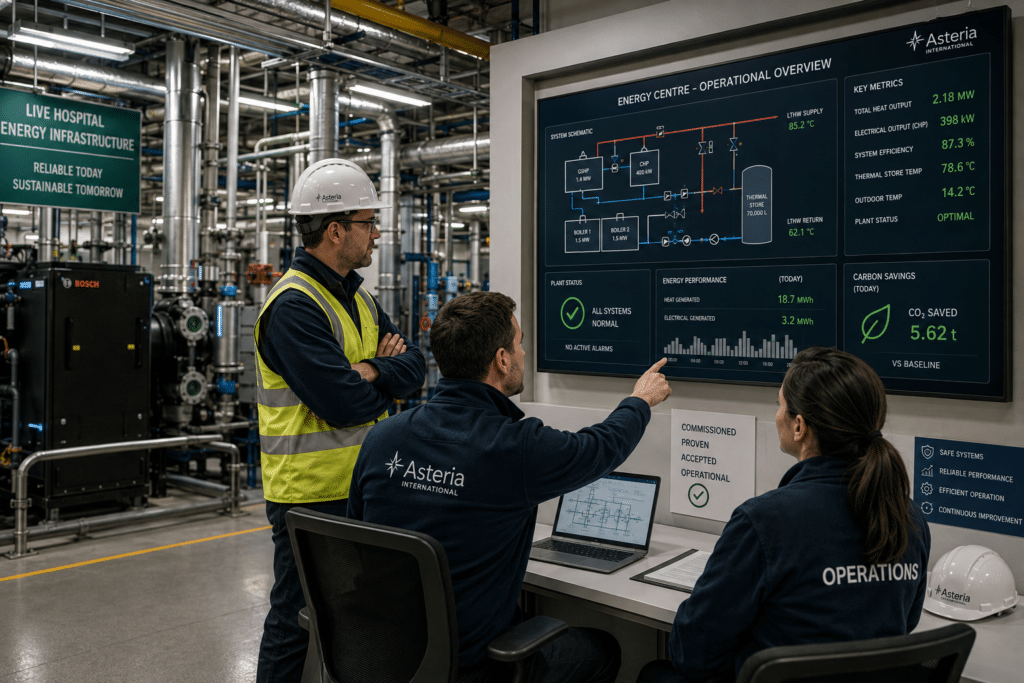
At Asteria International, we approach construction and commissioning within operational environments as part of integrated project delivery.
Our experience across healthcare, industrial manufacturing, energy and process environments has involved projects where significant construction and engineering modifications have had to progress while existing facilities remained operational.
These environments require considerably more than a construction programme and contractor coordination.
They require the people who understand the engineering, construction methodology, specialist packages, existing assets, operational requirements, risks and commissioning strategy to contribute to how the work will actually be delivered.
Our role is to help bring those parties together, establish the constraints and interfaces, evaluate the risks and formulate a practical delivery strategy.
That strategy can then be translated into a coordinated construction and commissioning programme.
Our approach focuses on:
- construction strategy and sequencing;
- contractor and specialist supplier coordination;
- buildability and work-package interfaces;
- operational interfaces;
- construction and operational risk;
- shutdown and isolation planning;
- recovery and reversion arrangements;
- defined hold points and acceptance criteria;
- access and site logistics;
- temporary systems and resilience;
- health, safety and quality;
- change and emerging site conditions;
- commissioning and performance proving; and
- operational readiness.
For critical changeovers, particular attention is given to understanding when it is safe to move forward and what recovery position remains available if the project cannot.
The objective is to create a delivery strategy that is technically achievable, operationally workable and capable of being executed safely without unnecessarily exposing the existing operation.
In live hospitals and manufacturing facilities, protecting the operation is not secondary to progressing the project.
It is part of successfully delivering the project.
Conclusion
Construction and commissioning in a live operational environment are ultimately about managing a controlled transition.
The project starts with an existing facility that is performing a function.
It needs to finish with new or modified infrastructure performing that function safely and reliably.
What happens between those two states is where much of the project risk sits.
The strategy cannot be developed effectively by one party working in isolation. It requires input from the people who understand the engineering, construction methodology, specialist packages, existing facility, operational requirements and commissioning process.
Bringing that knowledge together allows the project to develop the sequence, identify the interfaces, evaluate the risks and establish the controls needed to protect the operation.
For critical interventions, the strategy also needs an available recovery position.
That recovery position needs to exist before the changeover begins, remain available for as long as the project depends upon it, and only be surrendered when the agreed testing, commissioning and acceptance criteria demonstrate that it is safe to do so.
This makes commissioning part of the construction strategy rather than an activity added at the end.
Good construction management therefore creates a controlled route through:
Existing Operation → Enabling Works → Construction → Testing → Commissioning → Proving → Operational Acceptance → Future Operation
At each stage, the project needs to know what condition it has achieved, whether it is safe to move forward and, where necessary, how it can recover.
That is particularly important in hospitals and manufacturing facilities, where an unexpected construction problem must not be allowed to become an operational failure.
The objective is not simply to complete the construction. It is to manage the transition while protecting the operation throughout.
References & Further Reading
This Insight draws on Asteria International’s project delivery experience alongside established construction-management and health-and-safety practice. The following sources provide further guidance on a number of the principles discussed.
[1] Health and Safety Executive (HSE) — Protecting the Public: Your Next Move (HSG151). Includes guidance relating to construction work undertaken in or near occupied premises and the need to consider risks to occupants when planning and carrying out the works.
[2] Health and Safety Executive (HSE) — Guidance on Permit-to-Work Systems. Provides guidance on formal work-control arrangements for higher-risk and non-routine activities, including construction, alteration and modification, particularly where activities and responsibilities need to be coordinated between different groups.
[3] Health and Safety Executive (HSE) — Managing Health and Safety in Construction: Construction (Design and Management) Regulations 2015 — Guidance on Regulations (L153). Provides guidance on planning, managing and monitoring the construction phase and controlling risks to workers and others affected by construction activities.
[4] Chartered Institute of Building (CIOB) — What is Construction Management? Describes construction management as a discipline spanning the development, conservation and improvement of the built environment, including buildings, infrastructure, power and utilities.
[5] Chartered Institution of Building Services Engineers (CIBSE) — Commissioning Code M: Commissioning Management. Provides guidance on the management of commissioning throughout the project lifecycle, including commissioning planning, responsibilities, documentation, programme integration, testing, handover and the transition of building services into operation.