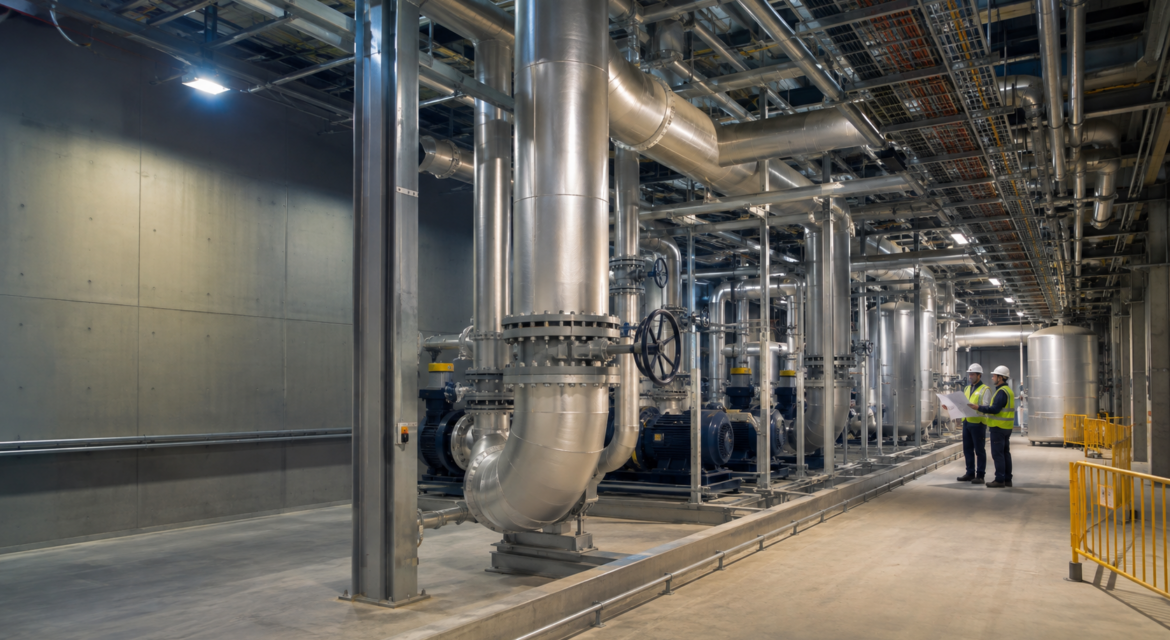
Construction management is the point at which a project’s design, programme, procurement strategy and engineering intent are tested against the practical realities of delivery.
It is where drawings become installed systems, planned activities become work packages and theoretical sequences are tested against access restrictions, existing services, site conditions, specialist contractor availability and operational requirements.
For straightforward projects in unoccupied environments, this can be relatively contained. For complex engineering, infrastructure, healthcare, manufacturing and energy projects, construction management becomes a far more demanding discipline.
Works may need to progress within live facilities. Existing plant and services may remain operational. Shutdowns may be limited to narrow windows. New systems may need to connect into old infrastructure. Multiple specialist contractors may be working within the same area. The commissioning strategy may need to be considered before the construction sequence is finalised.
In these environments, construction management is not simply contractor coordination. It is the process of bringing together the people, information, controls and decisions required to deliver the work safely, efficiently and without losing control of the wider project.
The Construction Phase Is Where Assumptions Are Tested
A project can look well developed during feasibility, design and procurement, yet become difficult once physical works begin. Existing services may not match drawings. Access routes may be constrained. A plant shutdown may require more planning and stakeholder involvement than anticipated. Equipment may arrive before its installation area is complete. A late design decision may alter the sequence of multiple work packages.
These are not unusual events. They are the normal realities of delivering complex projects in real environments. The difference between a controlled project and a reactive one is whether those constraints are identified early, assigned to the right owner and managed through a clear construction plan.
Construction management provides the practical link between the project’s intended delivery strategy and what can actually be achieved on site. It tests whether the next phase of work is genuinely ready to proceed, rather than simply assuming that it is because it appears on a programme.
Managing Interfaces Is the Core of Effective Construction Delivery
Most construction problems do not arise within a single work package. They arise at the interface between packages, disciplines and stakeholders.
A civil contractor may complete a base or plinth, but mechanical equipment cannot be installed until access is available, lifting arrangements are agreed, supports are coordinated and electrical supplies are ready. A controls installation may be physically complete, but cannot be tested until the mechanical system is proven, the relevant communications infrastructure is live and the operating team is available to witness the work.
These interfaces need to be actively managed. They should not be left to informal conversations between contractors or assumed to resolve themselves as the work progresses.
Effective construction management makes each dependency visible. It establishes who owns it, what information or action is required, when it is needed and what effect a delay will have on the wider programme. This creates a controlled route through the work rather than a series of disconnected activities competing for access, information and resources.
A Construction Programme Must Reflect the Reality of the Site
A programme is only useful if it reflects how work will actually be delivered. A sequence that appears logical in a planning room may be impossible on site because of operational restrictions, access limitations, permit requirements, delivery constraints or the availability of specialist labour.
Construction management therefore requires a detailed understanding of the environment in which the work is being undertaken. This includes:
- Access, egress and delivery routes.
- Site logistics, storage, lifting and laydown requirements.
- Permit-to-work, isolation and shutdown arrangements.
- Temporary works and safe systems of work.
- Interfaces with operational teams, maintainers and end users.
- Information release, procurement and equipment lead times.
- Testing, commissioning and handover requirements.
These factors must be considered before work begins, not once a contractor is already mobilised and waiting for a workfront. A properly developed short-term construction plan should identify the work planned for the coming weeks, the constraints that could prevent it and the actions needed to remove those constraints in time.

Workfront Readiness Must Be Proven, Not Assumed
One of the most effective controls during construction is to ask a simple question before committing labour and equipment: is the workfront genuinely ready?
Readiness means more than having an activity shown on the programme. The design information must be sufficiently complete. Materials must be available. Access must be agreed. Relevant permits and isolations must be achievable. Preceding works must have been completed and accepted. The workforce must understand the scope, method and interfaces of the activity.
Where any of those conditions are missing, the project should treat the activity as constrained. This allows the issue to be resolved before it turns into lost productivity, unplanned re-sequencing or a commercial dispute.
In live environments, this discipline is particularly important. A missed isolation window or incomplete permit arrangement can delay work for days or weeks. Construction management brings the project team, operator, contractor and specialist suppliers together early enough to confirm that the work can proceed safely and as planned.
Construction Progress Must Be Measured Against Defined Evidence
Construction progress can become misleading when it is based on broad percentage-complete estimates rather than clear evidence of what has actually been achieved.
A work package may be described as substantially complete, but the outstanding elements may include testing, quality records, interfaces, controls integration, commissioning support or operator acceptance. These activities can determine whether a system is genuinely ready to move forward.
Good construction management defines what “complete” means for each critical work package and system.
That definition should include the physical installation, inspection requirements, quality records, testing, commissioning prerequisites, documentation and acceptance criteria needed by the next responsible party.
Installation is not the same as completion. Completion is not the same as successful testing. Successful testing is not the same as demonstrating that a system can operate safely, reliably and as intended.
Measuring progress against these defined conditions gives the client and project team a more realistic view of delivery. It reduces the risk of apparently advanced work packages carrying significant hidden activity into the final stages of the project.
Change and Emerging Site Conditions Need Proper Control
Construction is the stage at which many changes become urgent.
An existing condition may differ from the available information. A technical solution may prove difficult to install. An operational requirement may alter. A route may become unavailable. A vendor may identify a late interface issue. A client decision may change the scope or sequence of works.
Some change is inevitable. The important issue is whether it is identified, assessed and controlled before it affects the wider delivery strategy.
Every material change should be understood in terms of its technical implications, programme effect, cost consequence, operational risk and impact on the remaining sequence of work. The project then has a basis on which to make a decision, rather than simply responding to the most immediate site pressure.
Clear contemporaneous records are essential. Site instructions, photographs, meeting minutes, drawings, technical queries, permits, programme updates and contractor correspondence all contribute to the evidence needed to establish what occurred, why it occurred and what impact it had.
Strong construction management protects the client’s position by maintaining that evidence as the work progresses, rather than attempting to reconstruct events after the programme or commercial position has already deteriorated.
Safety, Quality and Programme Must Be Managed Together
Safety, quality and programme are often discussed as separate project controls. In practice, they are closely connected.
A rushed sequence can create unsafe work conditions. Incomplete information can lead to rework. Poor-quality installation can delay testing and commissioning. A late change can introduce new hazards, disrupt planned isolations or compromise the ability to complete the work within an agreed operational window.
The purpose of construction management is not to trade safety or quality against programme. It is to plan and coordinate the work so that the project can achieve all three.
This requires visible leadership, clear responsibilities and effective communication between the client, project team, designers, contractors, suppliers and operational stakeholders. Each party needs to understand not only what they are doing, but how their work affects the wider sequence and what condition must be achieved before the next stage can proceed.
Construction Management Must Be Integrated with Commissioning and Handover
Construction should not be treated as a standalone phase that ends when the installation is physically complete.
The requirements for testing, commissioning, training, asset information, operation and maintenance documentation, performance proving and operational acceptance need to be considered while the construction strategy is being developed.
If commissioning requirements are left until the end, projects can discover that systems have been installed without the information, access, controls integration, temporary arrangements or vendor support needed to demonstrate performance.
A structured approach allows systems to be completed, inspected, tested and handed over progressively. Outstanding issues can be identified early. Commissioning activities can be aligned with the programme. Operators can understand what they are receiving and when. The project can move towards completion through defined evidence rather than a late rush to close multiple unresolved items.
Asteria International’s Approach
At Asteria International, we approach construction management as part of integrated project delivery.
Our experience across healthcare, industrial manufacturing, energy, infrastructure and process environments has involved projects where significant construction and engineering modifications have had to progress alongside existing operations, complex technical interfaces and demanding programme requirements.
These environments require considerably more than a construction programme and contractor coordination.
They require the people who understand the engineering, construction methodology, specialist packages, existing assets, operational requirements, risks and commissioning strategy to contribute to how the work will actually be delivered.
Our role is to help bring those parties together, establish the constraints and interfaces, evaluate the risks and formulate a practical delivery strategy.
That strategy can then be translated into a coordinated construction, testing, commissioning and handover programme.
Our approach focuses on:
- construction strategy and sequencing;
- contractor and specialist supplier coordination;
- buildability and work-package interfaces;
- design-information readiness and technical queries;
- operational interfaces;
- construction and operational risk;
- shutdown and isolation planning;
- access, site logistics and temporary works;
- defined hold points and acceptance criteria;
- health, safety, quality and construction assurance;
- change and emerging site conditions;
- testing, commissioning and performance proving; and
- operational readiness and handover.
For critical interventions, particular attention is given to understanding when it is safe to move forward and what recovery position remains available if the work cannot proceed as planned.
The objective is to establish a delivery strategy that is technically achievable, operationally workable and capable of being executed safely without unnecessarily exposing the existing operation.
In live hospitals, manufacturing facilities and operational infrastructure, protecting the operation is not secondary to progressing the project.
It is part of successfully delivering the project.
Conclusion
Construction management is ultimately about converting a complex delivery strategy into controlled activity on site.
The project may begin with an agreed design, programme and procurement plan, but successful delivery depends on whether the work can be sequenced, coordinated, resourced, controlled and accepted in the real environment in which it is being undertaken.
The highest risks often arise at the interfaces between engineering disciplines, specialist contractors, existing assets, operational teams and commissioning activities.
Those interfaces cannot be managed effectively by one party working in isolation. They require input from the people who understand the engineering, construction methodology, specialist packages, existing facility, operational requirements and commissioning process.
Bringing that knowledge together allows the project to establish a realistic sequence, identify constraints before they become delays, evaluate the risks and define the controls needed to maintain safe and reliable delivery.
Good construction management therefore creates a controlled route through:
Mobilisation → Enabling Works → Construction → Inspection → Testing → Commissioning → Proving → Operational Acceptance → Handover
At each stage, the project needs to know what condition has been achieved, whether it is ready to move forward and what action is required where it is not.
That is particularly important in live operational environments, where an unexpected construction problem must not be allowed to become an operational failure.
The objective is not simply to complete the construction. It is to deliver the required outcome safely, with the programme, quality, operational requirements and long-term performance properly protected throughout.
References & Further Reading
This Insight draws on Asteria International’s project delivery experience alongside established construction-management, work-control and health-and-safety practice. The following sources provide further guidance on a number of the principles discussed.
[1] Health and Safety Executive (HSE) — Protecting the Public: Your Next Move (HSG151). Includes practical guidance for those designing, planning, maintaining or undertaking on-site work, including the need to consider risks to people affected by work in occupied or operational environments.
[2] Health and Safety Executive (HSE) — Guidance on Permit-to-Work Systems (HSG250). Provides guidance on formal work-control arrangements for higher-risk and non-routine activities, including the coordination of responsibilities, hazards, precautions and isolations.
[3] Health and Safety Executive (HSE) — Managing Health and Safety in Construction: Construction (Design and Management) Regulations 2015 — Guidance on Regulations (L153). Provides guidance on planning, managing and monitoring the construction phase and controlling risks to workers and others affected by construction activities.
[4] Cabinet Office — The Construction Playbook. Sets out UK public-sector guidance on how public works projects and programmes should be assessed, procured and delivered, including the importance of planning, risk management, outcome-based delivery and a joined-up approach to the supply chain.
[5] Government Project Delivery — The Teal Book: Project Delivery in Government. Provides a UK government code of practice covering the management of portfolios, programmes and projects, including planning, control, risk and solution delivery.