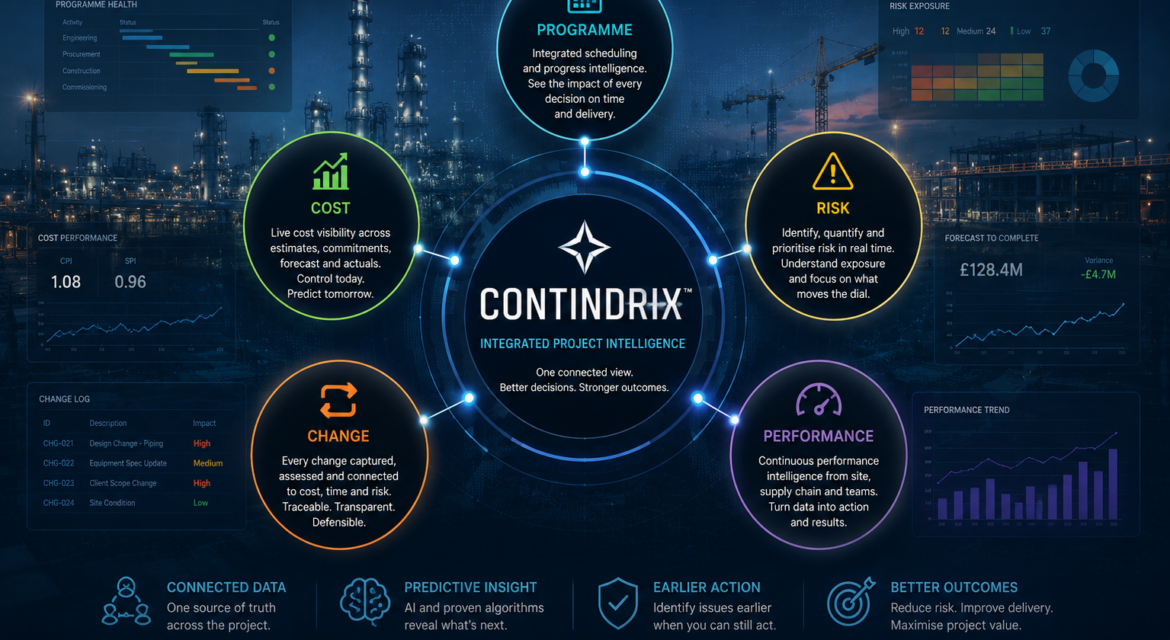
Project delays rarely begin with a missed completion date. They begin much earlier, when small changes in engineering, programme, cost, risk and delivery performance stop being understood as part of the same picture.
Complex capital projects generate enormous quantities of information. Engineering deliverables, procurement schedules, construction programmes, cost reports, technical queries, risk registers, change notices and supplier progress reports are produced continuously throughout the project lifecycle.
The challenge is rarely a lack of information.
The challenge is understanding what that information is actually telling you.
On many projects, these different sources of information are managed through separate systems, teams and reporting processes. Each may appear reasonable when considered independently, while the combined project position is already beginning to deteriorate.
By the time the master programme formally reports significant delay, the underlying conditions may have existed for weeks or even months.
This is why effective project control requires more than monitoring dates. It requires an integrated understanding of programme, cost, risk, change and performance.

1. Programme: The Schedule Is Only Part of the Story
A programme can remain apparently healthy while the conditions required to achieve it are steadily deteriorating.
An activity may still show its contractual completion date as achievable, but engineering information could be arriving late, procurement durations may be increasing, interfaces may remain unresolved or the resources necessary to execute the work may simply not be available.
The important question is therefore not only:
“Is the activity currently late?”
It is:
“Are the conditions required to complete this activity still credible?”
This distinction is fundamental.
Effective programme intelligence examines critical and near-critical activities, dependencies, float consumption, resource requirements, engineering maturity, procurement status and interfaces between disciplines.
A schedule should therefore operate as a model of project delivery rather than simply a graphical representation of dates.
2. Cost: Financial Performance Needs Context
Cost reports provide another important view of project performance, but financial information considered independently can also create false confidence.
Actual expenditure may remain below forecast because work is progressing efficiently.
But equally, expenditure may be low because engineering is late, purchase orders have not been placed, construction resources have not mobilised or planned work has simply not occurred.
The numbers can look positive while the project position is becoming progressively worse.
Effective project control therefore requires cost information to be understood alongside programme and physical progress.
Commitments, actual expenditure, forecast cost, earned progress and emerging change should tell a consistent story.
When they do not, the difference deserves investigation.
3. Risk: A Register Is Not Risk Management
Most major projects maintain a risk register.
That does not necessarily mean risk is actively influencing project decisions.
Risk registers can gradually become administrative documents: risks are recorded, scored, assigned and reviewed periodically without being fully connected to the activities, costs and decisions they could ultimately affect.
The real value comes from understanding exposure.
If an engineering decision remains unresolved, what activities depend upon it?
If a critical supplier is experiencing difficulty, what programme milestones are exposed?
If a risk materialises, what could the potential cost and schedule consequences be?
Connecting risk directly to programme, commercial and technical information changes the conversation from recording uncertainty to actively managing its potential consequences.

4. Change: Small Decisions Can Create Large Consequences
Change is inevitable on complex capital projects.
Design development, operational requirements, technical discoveries, regulatory changes, client decisions and site conditions all create legitimate reasons for projects to evolve.
The problem is rarely the existence of change itself.
The problem is understanding its cumulative effect.
A relatively minor technical modification may appear insignificant when assessed individually. But that modification may affect engineering documents, equipment specifications, procurement, fabrication, installation, commissioning and ultimately the critical path.
Several apparently minor changes occurring simultaneously can create a substantial programme and commercial impact.
Effective change management therefore requires traceability.
A change should not exist solely as a commercial variation. Its consequences should be visible across engineering, programme, cost, risk and construction.
5. Performance: Reported Progress Must Be Credible
Perhaps one of the most important questions in project control is also one of the simplest:
“Does the reported progress make sense?”
Progress reporting frequently relies upon percentages supplied by contractors, suppliers or individual disciplines. Those percentages can provide useful information, but they should not automatically be treated as objective evidence of actual performance.
Progress needs context.
If a supplier reports substantial engineering progress, does the volume of completed documentation support that position?
If construction progress is accelerating, are the necessary labour resources actually present?
If fabrication is approaching completion, have the required materials been purchased and delivered?
If a programme assumes a particular rate of installation, is that productivity credible when compared with the resources available and the physical constraints of the site?
Testing reported performance against engineering quantities, resource profiles, procurement status, historical norms and physical progress can reveal inconsistencies considerably earlier than conventional reporting.
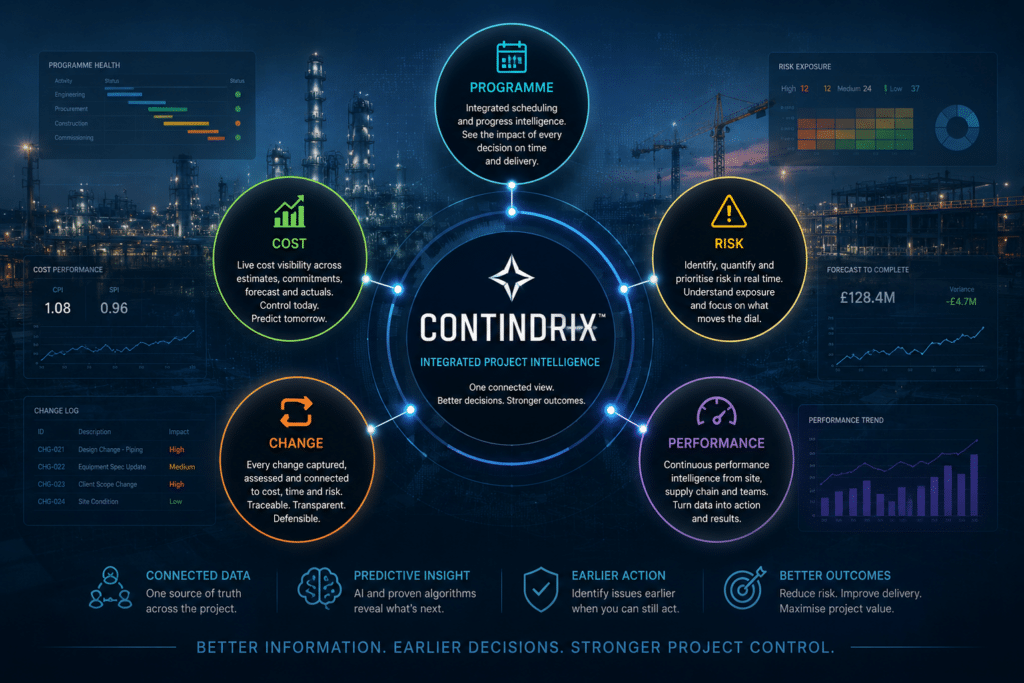
From Project Reporting to Project Intelligence
None of these disciplines operates independently.
Programme affects cost. Engineering maturity affects procurement. Procurement affects construction. Change affects programme and commercial exposure. Risk influences all of them.
The greatest opportunity therefore comes from understanding the relationships between project information rather than simply producing more reports.
This is the principle behind integrated project intelligence.
Instead of asking individual teams whether engineering, procurement, construction, cost or programme performance is satisfactory, project leadership can ask a more important question:
“Does the combined evidence support the reported project position?”
That change in perspective can identify emerging problems significantly earlier.
The Role of Experience and Structured Knowledge
Technology can help identify patterns, relationships and anomalies within increasingly complex project datasets, but technology alone cannot successfully manage major capital projects.
Engineering judgement, delivery experience and contextual understanding remain fundamental.
Historical knowledge is particularly valuable.
Understanding how long engineering activities normally require, what resources are realistically needed to achieve particular outputs, how suppliers typically progress through fabrication or how construction productivity changes under different site conditions provides an important reference point against which current performance can be tested.
Structured correctly, that experience becomes organisational knowledge rather than remaining solely within individual project teams.
This is where Contindrix™, Asteria International’s proprietary project intelligence and delivery framework, supports experienced professionals.
Contindrix™ brings programme, engineering, commercial, construction, risk and operational information together within a structured decision-support environment, helping project teams identify relationships, challenge assumptions and recognise emerging threats to delivery.
The objective is not to replace professional judgement.
It is to give experienced people better information on which to exercise it.
Earlier Visibility Creates More Options
The value of identifying a project problem early is not simply knowing that a problem exists.
It is having time to do something about it.
An emerging engineering delay identified several months before construction may allow work to be resequenced.
A developing supplier problem identified during manufacture may allow increased surveillance, revised payment controls or alternative sourcing strategies.
An emerging resource constraint may allow additional capability to be mobilised before it affects the critical path.
Once these issues appear as formal project delay, the available options are usually fewer, more expensive and considerably more disruptive.
That is why complex projects frequently lose control before they lose time.
The warning signs are often already present.
The challenge is connecting them early enough to act.
Better Information. Earlier Decisions. Stronger Project Control.
Better project outcomes do not come from producing more information. They come from understanding the information that already exists — earlier, more clearly and in context.