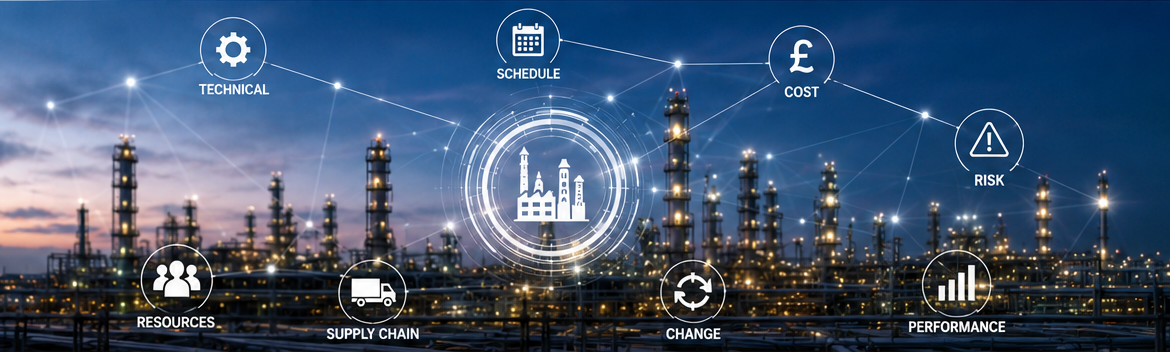
Complex engineering projects create risks that cannot be understood through a risk register alone.
Technical systems interact. Engineering decisions affect procurement and construction. Supply-chain constraints influence programme performance. Stakeholder decisions alter priorities. Regulatory requirements evolve. Resources become constrained. Changes in one part of the project can create consequences somewhere entirely different.
Traditional risk management remains important, but on complex projects it must form part of a much wider system of project control.
The objective is not simply to identify more risks. It is to understand how uncertainty moves through the project, how individual risks interact and where intervention can have the greatest effect.
1. Complexity Changes the Nature of Project Risk
On relatively straightforward projects, risks can often be considered individually.
Complex engineering projects behave differently.
Mechanical, electrical, civil, process, controls, structural and operational systems may contain hundreds of interfaces. Contractors and suppliers operate through different commercial arrangements. Design information develops at different rates. Decisions made within one discipline can affect several others.
This creates interdependency risk.
A late equipment decision, for example, may initially appear to be an engineering issue. But its consequences could extend into procurement lead times, structural requirements, electrical demand, controls architecture, construction sequencing, commissioning and ultimately project completion.
The real exposure therefore lies not only in the original event but in the chain of consequences it creates.
Effective risk management needs to recognise those relationships.
2. Technical Risk Requires Technical Understanding
Not every engineering uncertainty can be adequately represented by a probability and impact score.
Where the consequence of technical failure is significant, more detailed analysis may be required.
Depending upon the system and project, techniques such as Failure Modes and Effects Analysis (FMEA), Failure Modes, Effects and Criticality Analysis (FMECA), Fault Tree Analysis (FTA), finite element analysis or computational modelling can help teams understand failure mechanisms and consequences.
The technique should always be proportionate to the problem.
The objective is not to introduce complexity for its own sake. It is to obtain enough technical understanding to make an informed decision.
Systems engineering can be particularly valuable where multiple components and disciplines interact. Rather than considering individual assets in isolation, the project team considers how the complete system is intended to function and where interfaces create potential vulnerabilities.
This becomes increasingly important as projects combine mechanical infrastructure, electrical systems, automation, digital controls and operational technology.
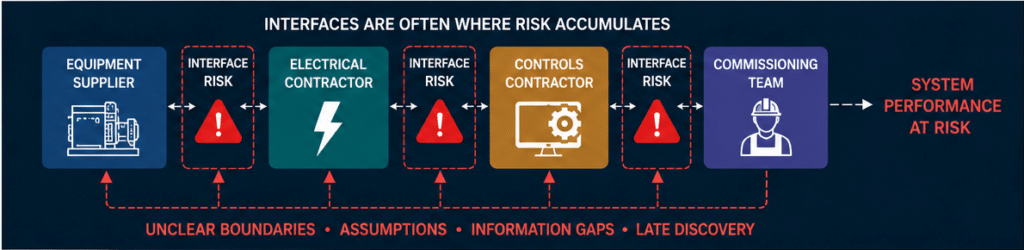
3. Interfaces Are Often Where Risk Accumulates
Individual organisations can perform their own scope competently while the overall project still encounters serious difficulty.
Why?
Because nobody owns the space between the scopes.
An equipment supplier may define its termination point. The electrical contractor may work to another boundary. The controls contractor may assume information will be provided by the equipment vendor. The commissioning team may discover much later that the interfaces do not operate as intended.
Each package can appear substantially complete while the system remains incomplete.
Interface management should therefore be treated as a core element of project risk management.
Responsibilities need to be explicit. Required information needs owners and dates. Technical boundaries need to be understood. Dependencies between design, procurement, construction and commissioning need to be visible.
The earlier these interfaces are identified, the greater the opportunity to resolve them without affecting physical delivery.
4. Risk Must Be Connected to Programme and Cost
A common weakness in project risk management is that the risk register sits separately from the programme and commercial forecast.
The project may therefore report a significant schedule risk while continuing to show an unchanged completion date.
Or it may identify procurement uncertainty without reflecting the potential cost consequences.
This creates a false sense of certainty.
Significant risks should be capable of being traced into the areas of project performance they could affect.
If an engineering approval is uncertain, what activities depend upon it?
If specialist equipment is delayed, what happens to installation and commissioning?
If access is restricted, what happens to productivity?
If a supplier is underperforming, what does that mean for forecast completion and commercial exposure?
Connecting risk, cost and programme changes the discussion from:
“What risks do we have?”
to:
“What could these risks actually do to the project?”
That is a much more useful management question.
5. Quantifying Uncertainty Where It Matters
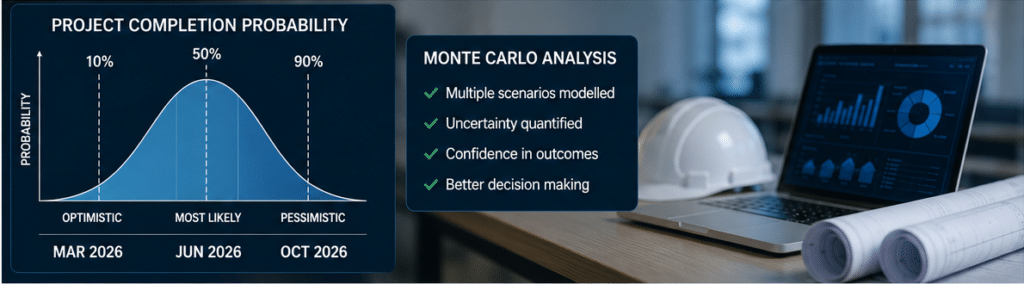
A deterministic programme produces a single completion date.
A deterministic estimate produces a single forecast cost.
But complex projects rarely contain deterministic conditions.
Activity durations vary. Productivity changes. Procurement dates move. Design develops. Risks occur with different probabilities and consequences.
Where uncertainty is material, quantitative techniques such as probabilistic risk analysis and Monte Carlo simulation can help teams understand a range of potential outcomes rather than relying solely upon one forecast.
This does not mean every project needs sophisticated modelling.
Quantitative analysis is most valuable where the decision justifies it — major investment decisions, critical milestones, significant commercial exposure or areas containing substantial uncertainty.
Used appropriately, it can help management understand whether a stated completion date represents a realistic level of confidence or merely the current deterministic baseline.
6. Risk Is Also About Resources and Supply-Chain Capacity
Risk management often concentrates on discrete events while overlooking the capacity of the organisations expected to deliver the project.
A supplier may have a technically acceptable programme but insufficient engineering resources to achieve it.
A contractor may be committed across several projects simultaneously.
Specialist skills may be available only during limited periods.
Manufacturing capacity may be constrained.
These conditions can create project risk long before a formal milestone is missed.
Resource profiles, engineering throughput, procurement performance, manufacturing progress and construction productivity can therefore provide important indicators of emerging exposure.
The key question is not simply whether a supplier reports that it is on programme.
It is whether the evidence supports the claim.
7. Regulatory and Environmental Risk Must Be Planned
Complex projects frequently operate within demanding regulatory environments.
Planning conditions, environmental permits, grid requirements, safety regulations, technical standards and operational approvals can all become critical dependencies.
These requirements should not sit outside the project programme as administrative activities.
Where an approval controls design, construction, testing or operation, it is a project dependency and should be managed accordingly.
Regulatory risk is particularly significant where project delivery depends upon third-party decisions whose timing cannot be completely controlled by the project team.
The programme must therefore recognise not only the submission date but the review period, potential queries, resubmissions and consequences of delayed approval.
This allows regulatory uncertainty to be managed as part of the delivery strategy rather than discovered when it becomes a constraint.
8. From Periodic Risk Reviews to Early Warning
Traditional risk processes often operate periodically.
Registers are reviewed monthly. Scores are adjusted. Actions are updated. Reports are issued.
That remains useful, but modern projects generate considerably more information than a periodic risk review can capture.
Engineering progress, procurement status, programme movement, change, cost performance, supplier behaviour and construction productivity can all provide signals that project conditions are changing.
The opportunity is therefore to move from simply recording known risks towards identifying patterns associated with emerging risk.
For example, repeated movement of intermediate milestones may indicate a developing programme problem before the contractual completion date moves.
Increasing numbers of technical queries may indicate insufficient design maturity.
Changes in supplier resource levels may indicate capacity constraints.
Growing change activity may signal deteriorating scope control.
Individually these indicators may appear manageable. Collectively they may tell a very different story.
9. Risk Management Is a Decision-Making System
Ultimately, the purpose of project risk management is not to maintain a risk register.
It is to improve decisions.
Good risk management enables project leaders to understand uncertainty, challenge assumptions, prioritise intervention and allocate resources where they can have the greatest effect.
That requires technical judgement as well as data.
Sophisticated models cannot compensate for poor information, and technology cannot replace experienced project leadership. Equally, experience alone can struggle to process the volume and interconnectedness of information generated by increasingly complex projects.
The strongest approach combines both.
From Risk Management to Predictive Project Intelligence
The evolution of project risk management is therefore not about abandoning traditional methods.
Risk registers, qualitative assessments, workshops and mitigation plans remain fundamental.
The opportunity is to connect them with engineering, programme, cost, change, resources and performance so that uncertainty is understood within the context of the whole project.
As these information streams become increasingly integrated, project teams can begin to recognise emerging conditions earlier, test the credibility of forecasts and understand how changes in one area may influence another.
That is the progression from recording project risk towards predictive project intelligence.
Complex projects will always contain uncertainty. The objective is not to remove it, but to see it early enough to remain in control.