Solar PV & Private-Wire Infrastructure Development
Integrated Project Leadership Through Feasibility, Development, Enabling Works & Pre-Construction
Sector: Renewable Energy / Net Zero & Decarbonisation
Client: Confidential
Location: United Kingdom
Contract Value: Confidential
Asteria International Services: Project Management | Engineering Management | Commercial Management | Construction Management | Project Controls & Risk Management
Project Overview
Asteria International was engaged under a professional services agreement to provide project leadership during the feasibility, development, enabling and pre-construction stages of a ground-mounted Solar PV and private-wire infrastructure project.
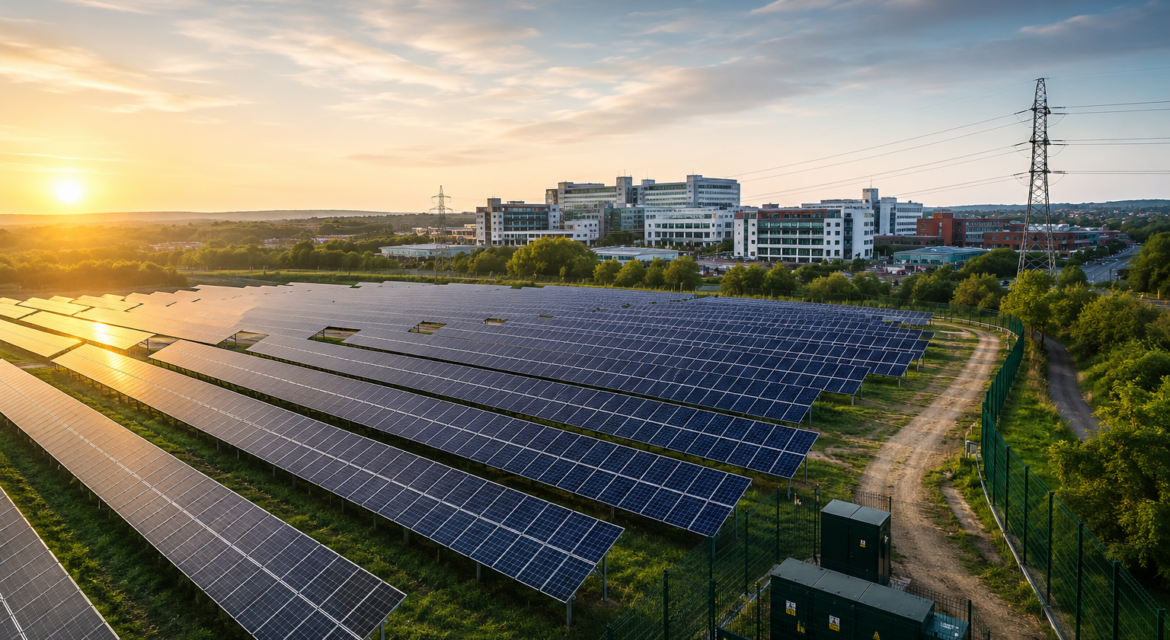
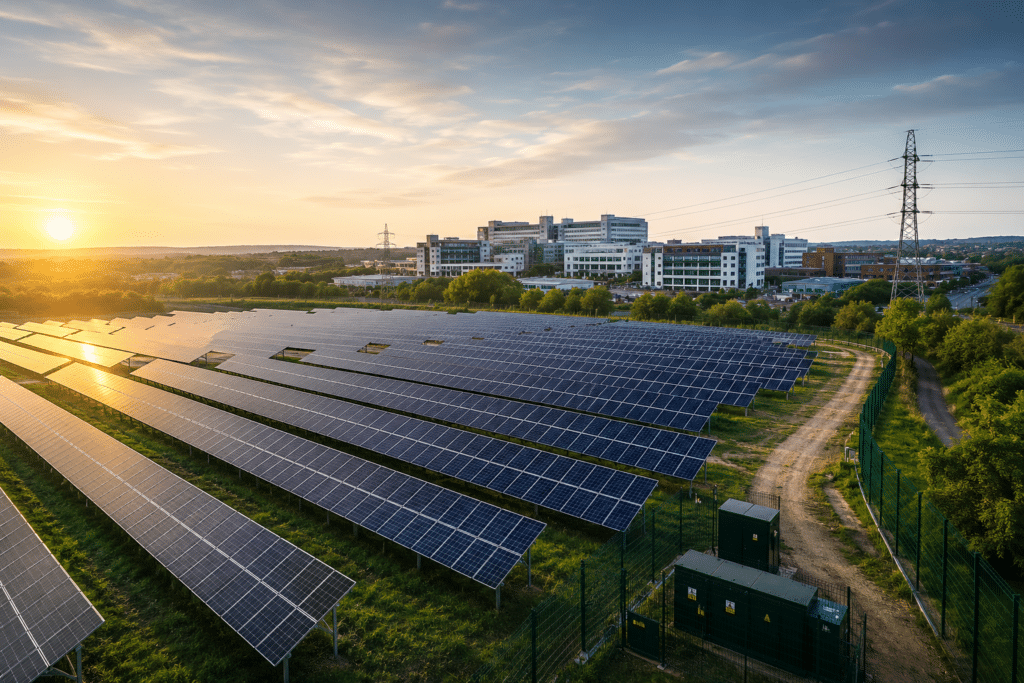
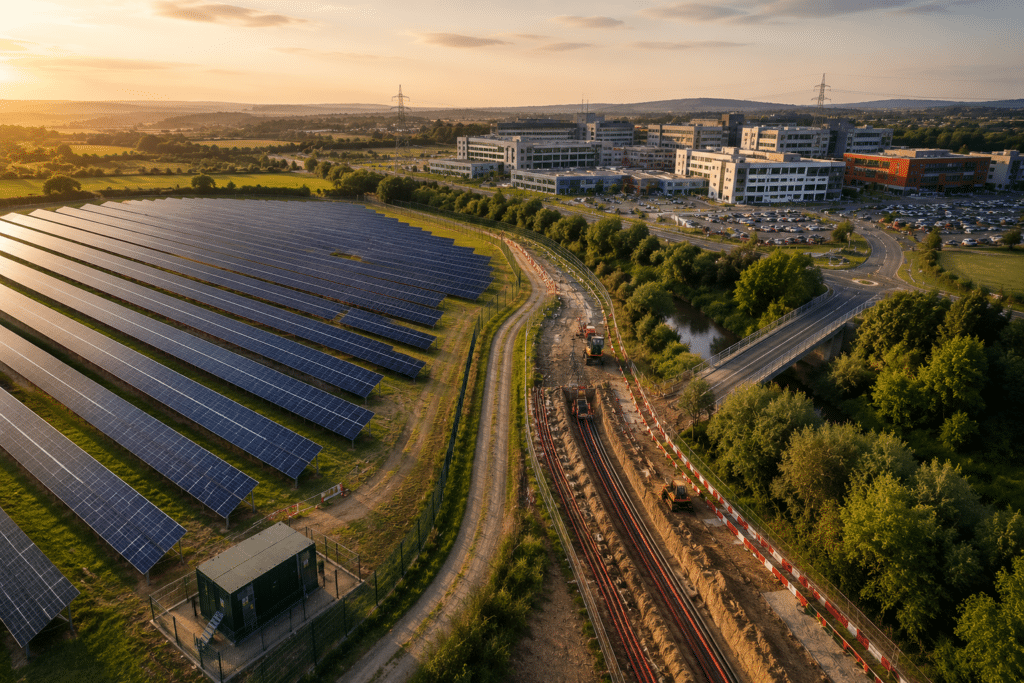
The proposed development involved the potential redevelopment of a challenging brownfield site for ground-mounted Solar PV, together with development of a private-wire connection between the proposed generation site and an operational healthcare estate.
The project required considerably more than assessment of the Solar PV installation itself.
Historic ground conditions, existing services, surveys, site access, environmental considerations, enabling works, private-wire feasibility, route development, DNO interfaces, existing electrical infrastructure, stakeholder requirements and constructability all needed to be progressively understood.
Asteria International coordinated these activities through the Project Manager appointment, maintaining alignment between technical development, commercial considerations, project controls, risk, health and safety, enabling works and pre-construction planning.
The objective was to progressively reduce uncertainty and establish whether the opportunity could be developed into a technically, commercially and practically deliverable infrastructure project.
The Challenge
Renewable-energy projects can encounter some of their most significant delivery challenges before principal construction begins.
The proposed Solar PV development was located on a complex brownfield site where historic land use introduced additional environmental, ground and construction considerations.
Although the site was no longer considered to be actively producing landfill gas, existing ground-protection measures, including membrane systems, still needed to be understood when planning surveys, enabling works and potential future construction activities.
Existing vegetation and woodland, ground conditions, access requirements, buried services, existing infrastructure, environmental constraints and survey requirements all needed to be progressively investigated.
At the same time, a viable means of transferring electricity from the proposed generation site to the operational healthcare estate needed to be established.
This introduced a separate but interconnected set of challenges around private-wire routing, DNO requirements, existing electrical infrastructure, buried utilities, highways, land interfaces, access, constructability and stakeholder requirements.
The challenge was therefore to progressively convert an initial renewable-energy opportunity into a sufficiently defined project upon which informed technical, commercial and investment decisions could be made.
Asteria International’s Appointment
Through the Project Manager appointment, Asteria International provided project leadership and coordination across feasibility, development, enabling and pre-construction activities.
The role included:
- Overall project leadership and development coordination
- Client interface and stakeholder management
- Feasibility and project-development management
- Project programme development, planning and forecasting
- Project reporting and governance
- Commercial and contractual management
- Procurement and contractor management
- Enabling works planning and management
- Contractor and specialist supplier coordination
- Private-wire feasibility and option development
- Route development and constructability assessment
- Project risk and opportunity management
- Project controls and development tracking
- Health and safety leadership and management
- Site access and logistics planning
- Survey and investigation management
- GPR and existing-services investigation management
- DNO and utility interface management
- Electrical infrastructure interface management
- Environmental, land and site-constraint management
- Project deliverables management
- Engineering management and technical-interface coordination
- Pre-construction planning and development
- Construction-readiness assessment
Asteria International worked alongside the client, contractors, surveyors and specialist technical organisations responsible for their respective areas of expertise.
The Project Manager role provided coordination across these interfaces so that information emerging from surveys, technical development and enabling activities could inform subsequent project decisions.
Feasibility & Project Development
Front-end development required uncertainty to be progressively converted into reliable information upon which project decisions could be based.
Asteria International coordinated inputs across site conditions, surveys, enabling requirements, technical interfaces, private-wire development, DNO requirements, existing infrastructure, project programme, commercial considerations, constructability and risk.
Potential constraints were considered in terms of their wider project consequences rather than solely within the discipline in which they originated.
Information obtained through site investigations, GPR and utility surveys, route assessments and specialist technical inputs was progressively incorporated into project development.
Historic ground conditions and existing ground-protection infrastructure were also considered when assessing potential future construction activities and associated project risk.
The purpose of feasibility was not simply to establish whether Solar PV generation was technically possible.
The generation asset, development site, private-wire connection and electrical interfaces needed to be considered together to understand the conditions and constraints that would determine whether the complete project could progress towards delivery.
Site Development & Enabling Works
The proposed development required preparation of the existing brownfield site to support further project development.
Asteria International managed enabling activities including site clearance and associated preparatory works.
Existing vegetation and woodland required clearance activities to be planned within the wider project while recognising environmental requirements, site access, health and safety and future development needs.
Historic use of the site introduced additional considerations.
Although active landfill-gas production was no longer considered a significant constraint, existing ground-protection infrastructure and membrane systems still needed to be understood and protected when considering intrusive activities and potential future construction methodologies.
Site preparation also needed to take account of buried services, existing infrastructure, ground conditions and information emerging from surveys and investigations.
Asteria International coordinated contractors and specialist inputs across these activities while maintaining visibility of project programme, logistics, commercial considerations, health and safety and risk.
The enabling works also provided an opportunity to improve understanding of the site and identify issues that could influence subsequent project development.
Surveys, Existing Services & Site Investigation
Understanding the existing environment was fundamental to progressing the project.
Existing-services information alone could not provide sufficient certainty for development of the private-wire route and associated infrastructure.
Asteria International managed site investigations, Ground Penetrating Radar surveys and associated utility investigations to improve understanding of buried services and physical constraints affecting potential areas of development.
Information emerging from these investigations was considered alongside existing records, site observations, route-development requirements and potential construction methodologies.
The objective was to reduce uncertainty before significant design, procurement or construction commitments were made.
Where previously unidentified constraints were discovered, their implications could be considered across route selection, engineering, constructability, programme, cost and project risk.
This provided a stronger basis for subsequent project decisions and reduced the potential for avoidable conflicts to emerge later in development or construction.
Private-Wire Feasibility & Route Development
A major element of the project was establishing a viable means of transferring electricity from the proposed Solar PV development to the operational healthcare estate.
Asteria International managed the project activities associated with feasibility, evaluation and development of the proposed private-wire connection.
This required considerably more than identifying a potential cable route.
The proposed connection extended beyond the generation site and required consideration of the physical, electrical and stakeholder constraints affecting its potential delivery.
Route development included consideration of:
- DNO requirements and interfaces with the existing electrical network
- Existing electrical infrastructure and connection requirements
- Existing buried services
- GPR and utility-survey information
- Existing-services records
- Route surveys and physical site investigations
- Highway and road-crossing interfaces
- Land, access and third-party constraints
- Existing structures and infrastructure
- Cable-routing and installation constraints
- Construction access and logistics
- Stakeholder and operational interfaces
- Constructability of alternative routing options
- Programme implications
- Commercial implications
- Project risk
Existing buried services represented a particularly important consideration.
GPR and utility investigations improved understanding of existing infrastructure along potential sections of the route and identified constraints capable of influencing routing and future construction methodology.
The electrical solution also needed to be considered alongside physical route feasibility.
Potential routes were therefore evaluated as multidisciplinary infrastructure solutions rather than simply as electrical cable routes.
Where constraints were identified, their implications for constructability, programme, commercial considerations, stakeholders and project risk could be considered while alternative options remained available.
DNO & Electrical Infrastructure Interfaces
The viability of the proposed generation project depended not only upon the Solar PV installation but also upon its ability to integrate with the wider electrical infrastructure.
Asteria International coordinated project interfaces associated with DNO requirements, existing electrical infrastructure and the proposed private-wire connection.
Electrical considerations needed to develop alongside physical route feasibility.
A route that appeared physically achievable still needed to support the proposed electrical strategy, while connection requirements could themselves influence infrastructure development, programme, commercial considerations and project risk.
These interfaces were therefore considered as part of the wider feasibility and development process rather than as isolated electrical activities.
Maintaining visibility across the proposed Solar PV development, private-wire route, point of connection, existing infrastructure and DNO requirements supported development of a more coordinated project proposition.
Engineering Management & Technical Interfaces
The project required input from specialist technical disciplines associated with renewable generation, electrical infrastructure, site development, existing services and the proposed private-wire connection.
Detailed engineering remained the responsibility of the appropriate specialist engineers and technical organisations.
Asteria International’s engineering-management role focused on coordinating the interfaces between these organisations and ensuring technical development remained aligned with programme, commercial, procurement, risk and constructability requirements.
This included maintaining alignment between the Solar PV development, private-wire requirements, existing electrical infrastructure, DNO interfaces, surveys and physical constraints identified along potential connection routes.
Technical information was considered within the context of the overall project-development strategy so that specialist activities contributed towards a coordinated proposition rather than developing independently.
Constructability & Pre-Construction Planning
Constructability was considered throughout project development rather than being deferred until detailed design or construction.
Potential solutions needed to account for how infrastructure could actually be installed within the constraints of the existing environment.
Access, buried services, ground conditions, existing structures, highways, operational interfaces, land constraints, site logistics and potential construction methodology could all influence the viability of proposed solutions.
Asteria International incorporated these considerations into feasibility and route development so that project decisions reflected practical delivery requirements.
This was particularly important for the private-wire infrastructure, where an electrically viable route could still present significant construction, programme or commercial challenges.
Considering constructability during development allowed these consequences to be understood while alternative solutions remained available.
Commercial & Procurement Management
Commercial considerations formed part of the development process throughout feasibility and pre-construction.
Decisions relating to enabling works, contractor engagement, technical solutions, private-wire options, route development and project strategy could influence capital requirements and overall project viability.
Asteria International managed commercial and contractual interfaces alongside technical development, project programme and risk.
Procurement and contractor activities were coordinated within the wider development strategy, including those associated with surveys, investigations and enabling works.
This allowed technical options to be considered alongside their potential commercial, procurement, construction and programme implications rather than solely against engineering criteria.
Project Controls & Development Management
Project controls during the development phase focused on the dependencies necessary to move the project towards greater definition and construction readiness.
Surveys, site preparation, vegetation and woodland clearance, enabling works, technical development, private-wire evaluation, DNO interfaces, procurement activities and stakeholder requirements each influenced the sequence and timing of subsequent decisions.
Asteria International maintained visibility of these dependencies through project planning, development tracking and reporting.
Where surveys or investigations identified additional constraints, their potential implications for programme, route development, commercial considerations and subsequent construction activities could be considered within the wider project position.
Project controls therefore supported decision-making and provided visibility of the relationships between technical development, programme, risk and commercial considerations.
Risk & Opportunity Management
Risk and opportunity management formed an integral part of front-end project development.
Site conditions, buried services, access, environmental constraints, existing infrastructure, route selection, DNO requirements, stakeholder interfaces and technical constraints all had the potential to influence project cost, programme and deliverability.
Historic ground conditions and existing ground-protection infrastructure were also considered, including the potential implications of intrusive activities for membrane systems and future construction methodology.
Asteria International maintained visibility of these developing risks and their relationship with the wider project.
GPR surveys, utility investigations, site investigations and route-development activities helped progressively reduce uncertainty and improve understanding of the physical constraints affecting the proposed infrastructure.
Where risks or constraints were identified, further investigation, mitigation or alternative approaches could be considered before major construction commitments were made.
Opportunities arising through alternative routes, construction approaches, sequencing or technical development could similarly be considered as project information matured.
Risk and opportunity management therefore supported active project development rather than simply documenting uncertainty.
Enabling Works & Construction Management
Although the project remained within development and pre-construction, physical enabling activities were undertaken to prepare the site and support further development.
Asteria International managed contractors and site activities associated with these works, including site preparation and clearance.
These activities required coordination of contractor access, logistics, health and safety, environmental considerations, programme and interfaces with the wider development.
The physical enabling works also provided further information about site conditions and practical delivery constraints.
Experience gained through these early activities could therefore inform subsequent project development and potential future construction planning.
Construction management at this stage focused on the enabling scope actually being undertaken and on improving readiness for potential principal construction.
Health & Safety Leadership
Health and safety remained integral throughout feasibility, investigation and enabling activities.
Site clearance, surveys, investigations, contractor activities and preparatory works introduced real site and construction risks before commencement of any principal Solar PV or private-wire works.
Asteria International’s role included health and safety leadership and coordination across these activities, maintaining alignment with contractor management, site access, logistics, enabling works and project planning.
The development phase also provided an opportunity to identify potential hazards associated with future construction and incorporate those considerations into route development, constructability assessment and proposed methodologies.
Health and safety was therefore incorporated into project development and decision-making from the outset rather than being deferred until principal construction.
Developing Construction Readiness
Construction readiness developed progressively as uncertainty was reduced and the principal project interfaces became better understood.
Site investigations improved understanding of existing conditions. GPR and utility surveys provided greater visibility of buried infrastructure. Enabling works addressed immediate site-development requirements, while private-wire assessment developed understanding of potential connection routes and associated constraints.
DNO requirements, existing electrical infrastructure, brownfield conditions, environmental considerations, constructability, commercial implications, health and safety and project risk continued to inform development of the proposed solution.
Asteria International coordinated these activities through the Project Manager appointment, maintaining continuity between the different strands of project development.
Construction readiness was therefore not treated as a single milestone.
It developed through feasibility, investigation, engineering coordination, commercial assessment, enabling works, risk reduction and constructability planning as the project moved towards greater definition.
Progressing the Project Towards Delivery
The development phase progressively converted an initial renewable-energy opportunity into a more defined and better understood infrastructure project.
Site investigations and utility surveys improved understanding of the existing environment. Enabling works addressed immediate site-development requirements, while private-wire assessment established the physical, electrical and stakeholder considerations associated with connecting the proposed generation asset to the healthcare estate.
DNO requirements, existing electrical infrastructure, brownfield constraints, buried services, route development, constructability, commercial considerations, health and safety and project risk were considered together as the project developed.
Asteria International coordinated these activities through the Project Manager appointment, working alongside the client, contractors, surveyors and specialist technical organisations.
This maintained continuity between feasibility, physical site investigation, enabling works and pre-construction planning, allowing emerging information to inform subsequent project decisions.
The result was a progressively developed project proposition with greater understanding of the principal technical, commercial, construction and delivery constraints that would need to be addressed before progression into principal construction.
From Feasibility to Construction Readiness
Early-stage renewable-energy development depends upon considerably more than establishing whether generation technology can be installed.
Site conditions need to be understood. Electrical connections must be viable. Cable routes need to be physically deliverable. Existing services and infrastructure need to be identified. Environmental and land constraints must be considered, and the commercial and construction consequences of developing solutions need to remain visible.
Asteria International brought these requirements together through Project Management, Engineering Management, Commercial Management, Construction Management and Project Controls & Risk Management, with Health & Safety embedded throughout the enabling and development activities.
The focus remained on progressively reducing uncertainty and developing a project capable of informed progression towards construction.
Complex Projects. Controlled Delivery.
Asteria International provides experienced project leadership for complex renewable-energy and infrastructure projects.
Our integrated approach brings together Project Management, Engineering Management, Commercial Management, Construction Management and Project Controls & Risk Management, supporting clients from feasibility and project development through procurement, construction, commissioning and close-out.