Client-Side Project Management, Engineering Management & MF/1 Contract Administration
Engagement Model: Client-Side Professional Services – Project Management | Engineering Advisory
Form of Contract: MF/1 General Conditions of Contract
Project Scope: High-Care Facility Expansion | Automated Processing | Industrial Refrigeration | M&E Infrastructure
Delivery Environment: Live 24/7 Food Manufacturing Facility | Tier-1 Plant Contractor
Asteria International Services: Project Management | Engineering Management | Construction Management | Commercial Management | Project Controls & Risk Management
Project Overview
Asteria International provided client-side project management and engineering leadership for a major expansion and automation project within a live high-care food manufacturing facility.
The investment was developed to increase manufacturing capacity in response to new customer demand and incorporated a major building extension, automated processing equipment, industrial refrigeration and extensive mechanical and electrical infrastructure.
The new facility needed to integrate directly with an existing 24/7 manufacturing operation.
This created a particularly demanding project environment. Construction, structural interfaces, utility connections and equipment installation needed to progress while existing production remained operational and established food-safety, hygiene and health and safety controls were maintained.
Asteria International integrated with the client’s engineering and operations teams, providing project leadership across engineering, construction, health and safety, programme, commercial management, commissioning and operational integration.
Asteria International also acted as the named Engineer under the MF/1 contract, providing independent technical and contractual administration of the principal plant contractor.
The Challenge
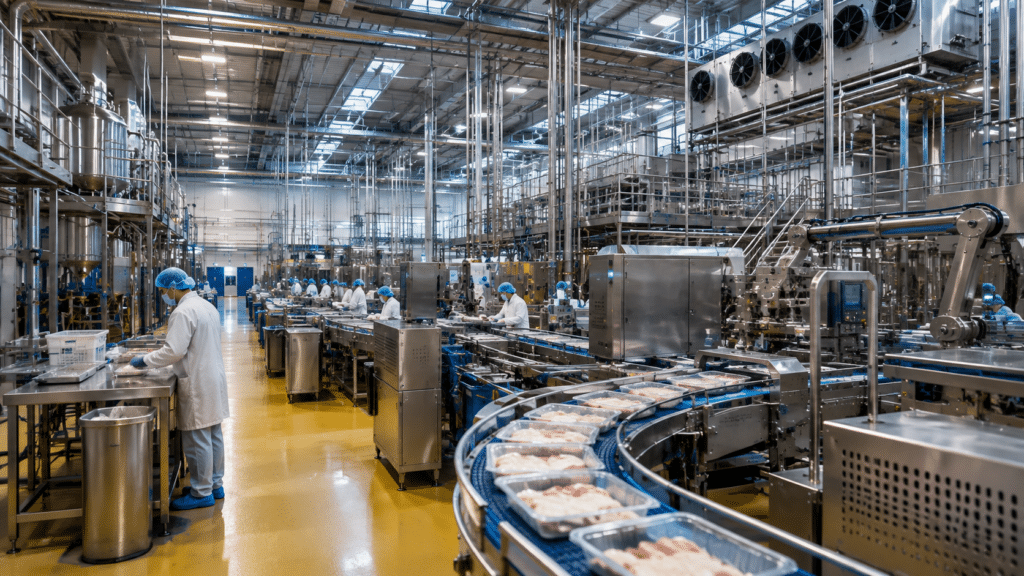
Expanding a high-care food manufacturing facility while maintaining live production created a combination of engineering, operational, health and safety and commercial risks.
The new building and process infrastructure physically interfaced with an existing manufacturing facility operating continuously.
Construction activities therefore needed to be carefully segregated from food-production environments, with particular attention given to workforce safety, dust, hygiene, access, utilities and the potential for construction activities to affect existing manufacturing operations.
The interaction between construction and live operations required particularly careful management.
Contractor personnel, construction plant, lifting activities, temporary works and installation activities needed to coexist with operational personnel, existing machinery and established site movements.
Production continuity was equally important.
Electrical, mechanical, refrigeration and other utility connections required carefully planned interfaces with existing systems. An uncontrolled shutdown or poorly coordinated changeover had the potential to create both operational and safety consequences.
The project also incorporated specialist automated processing and refrigeration equipment requiring coordination between building works, utilities, controls and process systems.
Successful delivery therefore depended on considerably more than completion of the building extension.
The project needed to be constructed safely, protect ongoing food production and ultimately demonstrate that the new systems could operate together as an integrated manufacturing facility.
Asteria International’s Role
Asteria International provided client-side project leadership and coordinated the principal contractor, specialist suppliers and client stakeholders throughout delivery.
The scope included:
- Client-side project management and project leadership
- Named Engineer responsibilities under MF/1
- Principal contractor and specialist supplier coordination
- Engineering management and multidisciplinary coordination
- Construction management and site coordination
- Health and safety leadership and contractor oversight
- Construction and operational interface management
- MF/1 contract administration
- Commercial and variation management
- Project risk and change management
- Independent master programme development
- Contractor programme review and challenge
- Construction and installation oversight
- Production interface and shutdown planning
- High-care construction segregation coordination
- Factory Acceptance Testing (FAT)
- Site Acceptance Testing (SAT)
- Commissioning and performance proving coordination
- Defects and close-out management
- Progress, programme and commercial reporting
The role provided the client with an integrated management function connecting engineering decisions with their construction, health and safety, operational, programme and commercial consequences.
Project Management & Live Manufacturing Integration
Asteria International provided day-to-day management of project delivery within the live manufacturing environment.
The expansion needed to progress alongside continuing production, requiring close coordination between the project team and the client’s engineering, operations, production and health and safety functions.
Construction sequencing was developed around the practical requirements of the existing facility.
Interfaces between new and existing structures, process areas and utilities were identified and coordinated before individual work fronts progressed.
Particular attention was given to activities capable of affecting production or creating interfaces between construction and operational personnel, including structural tie-ins, lifting activities, utility modifications, electrical works and the integration of new mechanical and refrigeration systems.
This enabled construction requirements to be considered alongside the operational and safety priorities of the manufacturing facility rather than being managed as an isolated building project.
Health, Safety & Construction Management
Health and safety was integral to the project-management approach throughout construction, installation and commissioning.
The project combined significant construction activities with a live manufacturing environment, creating interfaces between contractors, operational personnel, existing production equipment, new machinery and specialist engineering systems.
Asteria International coordinated with the client, principal contractor and specialist suppliers to ensure that planned activities were understood in the context of the wider operational facility.
Particular attention was given to the management of higher-risk and interface activities, including plant and equipment movements, lifting operations, temporary works, electrical and mechanical isolations, work around existing services and the installation of specialist process and refrigeration equipment.
Planned shutdowns and utility interventions required coordination between contractors and the client’s operational teams so that systems could be safely isolated, work completed and services returned to operation in a controlled manner.
Construction sequencing was also reviewed against the movement of operational personnel and the requirements of occupied production areas, reducing unnecessary interaction between construction activities and the operational workforce.
As the project moved into commissioning, the risk profile changed.
Energisation, equipment start-up, automated machinery, refrigeration systems and functional testing introduced different hazards from those encountered during construction. Commissioning activities therefore required controlled coordination between equipment suppliers, contractors and client personnel.
Health and safety was consequently treated as an integral part of engineering and project decision-making rather than as a separate reporting activity.
High-Care Construction & Production Protection
Construction immediately adjacent to high-care food production required controlled segregation between project activities and operational manufacturing areas.
Asteria International coordinated construction phasing and interface requirements with the client and contractor to maintain separation between construction and production environments.
Temporary barriers, access arrangements and construction sequencing were incorporated into the wider delivery strategy, with potentially disruptive activities planned around operational requirements.
Dust-producing works and physical connections between the existing facility and new extension required particular consideration.
Segregation arrangements therefore supported both food-safety requirements and the safe separation of construction personnel from operational manufacturing activities.
The objective throughout was to allow construction to progress without compromising either the safety of personnel or the hygiene controls required by the operational facility.
The project was delivered with no recorded production losses arising from construction-related contamination events.
Engineering & Technical Coordination
The project incorporated significant multidisciplinary engineering interfaces.
Structural works, automated processing equipment, mechanical services, electrical infrastructure, industrial refrigeration, controls and existing factory utilities all needed to operate within a coordinated design and installation strategy.
Asteria International provided engineering coordination across these interfaces, connecting specialist supplier requirements with the wider facility infrastructure.
Equipment loads, utility requirements, access, installation sequencing, maintenance requirements and controls interfaces needed to be understood before specialist systems arrived on site.
Engineering reviews also considered the implications of installation and commissioning activities for existing operational systems and personnel.
This was particularly important for automated process equipment and refrigeration plant, where supplier requirements could directly affect building services, construction activities and the safe operation of existing systems.
Technical decisions were therefore considered against the wider project rather than within individual supplier packages.
Independent Programme Control
Asteria International developed and maintained an independent logic-linked master programme using Microsoft Project.
The programme integrated building works, structural interfaces, specialist supplier equipment manufacture and delivery, M&E installation, utility connections, commissioning and production integration within a single project-control structure.
This provided the client with its own assessment of project progress rather than relying solely on contractor or equipment-supplier programmes.
Particular attention was given to long-lead specialist equipment and activities directly affecting the critical path.
Potential delays could therefore be considered against their effect on subsequent installation, commissioning and production-readiness activities.
The programme also provided the basis for coordinating critical utility interfaces, planned shutdowns and production activities.
Rather than viewing construction completion as the only significant milestone, the programme considered the complete sequence through installation, safe energisation, commissioning, validation and operational readiness.
MF/1 Contract Administration & Commercial Management
As the named Engineer under the MF/1 contract, Asteria International provided technical and contractual oversight of the principal plant contractor.
Contractor change submissions and requests for additional time or cost were assessed against the relevant project requirements, contract information, programme position and contemporaneous project records.
During delivery, contractor variation submissions totalled approximately £310,000.
Asteria International coordinated the technical, programme and commercial assessment of these submissions to establish the underlying requirement, contractual basis and reasonable consequence of each proposed change.
The purpose was not simply to reduce contractor quotations.
Each submission needed to be understood in the context of the engineering requirement, responsibility for the underlying event, actual project progress and its effect on delivery.
Following assessment and agreement through the project change-control process, approximately £95,000 of variation value was agreed.
This represented approximately £215,000 of cost avoidance against the contractor’s original submitted values.
The outcome demonstrates the value of combining contractual administration with engineering knowledge, project records and independent programme control.
Factory Acceptance Testing
Factory Acceptance Testing formed an important part of the equipment-delivery strategy.
Asteria International provided client-side coordination and oversight of FAT activities undertaken by the relevant specialist suppliers before equipment was released for delivery to site.
Testing provided an opportunity to verify equipment functionality, controls, safety functions and specified performance requirements before installation within the live manufacturing facility.
Issues identified during FAT could therefore be addressed before they became site problems, reducing the risk of defects or incomplete systems affecting installation and subsequent commissioning.
The FAT process was integrated into the master programme so that equipment readiness, delivery and site requirements remained aligned.
Installation, Commissioning & Site Acceptance Testing
Following delivery by the relevant suppliers, Asteria International coordinated the installation interfaces between the specialist plant, building services and existing manufacturing infrastructure.
Commissioning represented a critical stage of the project because successful completion required considerably more than demonstrating that individual pieces of equipment operated correctly.
Automated processing equipment, refrigeration systems, mechanical services, electrical infrastructure, controls and existing factory systems needed to operate together as an integrated production environment.
Asteria International coordinated commissioning interfaces between specialist suppliers, contractors and client operational stakeholders.
The transition from construction into commissioning also required careful management of responsibilities and work areas as systems became energised and operational.
Site Acceptance Testing was used to demonstrate that installed systems achieved their specified requirements within the operational facility.
Testing and commissioning activities therefore considered individual equipment performance, system integration, operational requirements and the safe transition of new assets into use.
Operational Readiness & Performance
The ultimate measure of project success was not simply completion of construction.
The expanded facility needed to be capable of supporting the client’s manufacturing requirements and transition safely and effectively into operation.
Asteria International coordinated the progression from construction through commissioning, acceptance and operational readiness.
Outstanding technical issues, commissioning activities and contractor defects were monitored through close-out, while interfaces with the client’s engineering and operational teams were maintained as systems transitioned into use.
The project achieved its required Taking-Over position approximately two weeks ahead of the baseline programme, providing additional time for equipment validation and operational preparation ahead of the client’s required production date.
Project Risk & Change Management
Risk management extended across health and safety, engineering, construction, production and commercial activities.
Potential issues associated with specialist equipment manufacture, delivery, utilities, construction interfaces, hygiene controls, commissioning and operational integration were considered against their potential effect on the overall project.
Where emerging risks were identified, Asteria International coordinated the relevant technical, contractor and client stakeholders to establish mitigation measures.
This integrated approach allowed individual issues to be understood in terms of their wider consequences.
A delayed equipment package, for example, was not simply a supplier issue. Its effect on installation, utilities, commissioning, production readiness, safe sequencing and the contractual position also needed to be considered.
The same approach was applied throughout delivery, linking project risk with health and safety, programme, engineering and commercial decision-making.
Protecting Production & Client Value
The combination of project management, engineering leadership, construction management, health and safety oversight, MF/1 contract administration and independent project controls provided the client with an informed position from which both delivery and expenditure could be managed.
Production continuity remained central to decision-making throughout construction and integration.
The project was delivered without recorded construction-related contamination events resulting in production loss and without unplanned production downtime attributable to the project works.
Commercially, approximately £310,000 of contractor-submitted variation value was assessed, with approximately £95,000 ultimately agreed.
The resulting £215,000 difference between submitted and agreed variation values demonstrated the benefit of informed technical and commercial assessment within the wider project-management function.
These outcomes were achieved while progressing a major capital expansion within a live high-care manufacturing environment.
Project Outcomes
Asteria International provided an integrated client-side project management and engineering function across a complex food manufacturing expansion and automation project.
Key outcomes included:
- Client-side project leadership across building, process, M&E and specialist equipment packages
- Asteria International acting as the named Engineer under the MF/1 contract
- Health and safety integrated across construction, installation, commissioning and operational interfaces
- High-care construction activities coordinated around continuing 24/7 production
- Construction and operational work areas managed to maintain appropriate segregation
- Planned utility isolations and system interfaces coordinated with operational stakeholders
- Automated processing equipment and industrial refrigeration delivered by specialist suppliers coordinated for integration with existing factory infrastructure
- Independent logic-linked master programme developed and maintained using Microsoft Project
- Specialist supplier equipment manufacture and delivery incorporated within overall project controls
- Factory Acceptance Testing and Site Acceptance Testing coordinated
- Integrated commissioning and operational-readiness activities managed
- Approximately £310,000 of contractor-submitted variations assessed
- Approximately £95,000 of variation value agreed
- Approximately £215,000 difference between submitted and agreed variation values
- Required Taking-Over position achieved approximately two weeks ahead of the baseline programme
- No unplanned production downtime attributable to the project works
- No recorded production loss resulting from construction-related contamination
The outcomes demonstrate the importance of integrating project management, engineering, construction, health and safety, programme and commercial control when delivering capital investment within an operational manufacturing environment.
Asteria International provided the client with an independent project position from which technical delivery, construction risk, production interfaces, programme performance and commercial exposure could be actively understood and controlled.
Conclusion
Capital investment within an operational food manufacturing facility creates a particularly demanding project environment.
Building works, process equipment, industrial refrigeration, M&E infrastructure, controls and specialist suppliers must be coordinated while protecting existing production, maintaining high-care hygiene requirements and ensuring construction and commissioning activities are undertaken safely.
Asteria International integrated these requirements within a single client-side project management and engineering function.
Project leadership coordinated the wider delivery team. Engineering management connected specialist process equipment with the facility infrastructure. Construction management and health and safety oversight supported the controlled delivery of works alongside live manufacturing. Independent project controls maintained visibility of manufacture, construction, installation and commissioning. MF/1 administration provided structured control of contractual change, while FAT, SAT and commissioning management supported the safe transition from installed equipment to an operational manufacturing facility.
For the client, Asteria International provided more than additional project resource. The appointment provided experienced client-side project and engineering leadership within a live high-care manufacturing environment, supported by the construction management, health and safety, project controls, commissioning and commercial capability required to maintain control of a complex capital investment.