Client-Side Project Management, Engineering Management & IChemE Red Book Contract Administration
Engagement Model: Client-Side Professional Consultancy – Project Management & Engineering Management
Form of Contract: IChemE Red Book – Lump Sum Contract for Process Plant
Project Scope: Process Automation | Blending Systems | Bulk Liquid Storage | Chemical Dosing | M&E & EC&I Infrastructure
Delivery Environment: Live 24/7 Process Manufacturing Facility | Hazardous-Area Installations | Specialist Contractors & Equipment Suppliers
Asteria International Services: Project Management | Engineering Management | Construction Management | Commercial Management | Project Controls & Risk Management
Project Overview
Asteria International was appointed as the client-side project management and engineering management consultancy for a major process automation and manufacturing expansion within a live chemical and fluids production facility.
The physical works were delivered by the client’s appointed principal contractor and specialist equipment suppliers. Asteria International did not supply or install the process plant or equipment; its role was to manage, coordinate and provide independent oversight of delivery on behalf of the client.
The project incorporated automated blending systems, bulk liquid storage, chemical dosing infrastructure, structural and civil works, process pipework, electrical infrastructure, instrumentation and controls.
New process systems needed to be integrated directly with an existing manufacturing facility operating continuously.
This created a complex brownfield delivery environment. Construction, equipment installation, hazardous-area electrical works, process connections and utility tie-ins needed to progress while existing production remained operational and established process-safety requirements were maintained.
Asteria International integrated with the client’s engineering and operations teams, providing professional project management across engineering, construction, health and safety, programme, commercial management, commissioning and operational integration.
Asteria International also undertook the Project Manager role within the IChemE Red Book contractual framework, providing independent client-side technical and contractual oversight of the principal process contractor.

The Challenge
Expanding a live process manufacturing facility created interconnected engineering, process-safety, operational, programme and commercial risks.
New blending, storage and dosing systems needed to be integrated with existing process infrastructure without unnecessarily disrupting ongoing manufacturing.
The project incorporated hazardous-area installations requiring appropriate consideration of ATEX and DSEAR requirements, alongside the wider management of process hazards associated with chemical storage, transfer and blending operations.
Construction activities also needed to interface safely with operational personnel, existing process equipment, utilities and established site movements.
Process and utility tie-ins represented particularly important project interfaces.
Electrical switchovers, process pipework connections, controls integration and modifications to existing services required carefully planned intervention within the operational plant.
An inadequately coordinated shutdown or system modification had the potential to affect both production and plant safety.
The client therefore required an experienced consultancy capable of providing independent project leadership across engineering, construction, process safety, programme, contractual and commercial requirements while the physical works remained the responsibility of the appointed delivery contractors.
Asteria International’s Role
Asteria International provided client-side project leadership, managing and coordinating the activities of the principal process contractor, specialist equipment suppliers and client stakeholders throughout delivery.
The scope included:
- Client-side project management and project leadership
- Project Manager responsibilities within the IChemE Red Book framework
- Principal contractor and specialist supplier coordination
- Engineering management and multidisciplinary coordination
- IChemE Red Book contract administration
- Commercial and variation management
- Project risk and change management
- Health, safety and process-safety oversight
- Hazardous-area engineering interface management
- Independent master programme development
- Contractor and supplier programme review and challenge
- Client-side construction monitoring and oversight
- Process and utility tie-in planning
- Factory Acceptance Testing (FAT) oversight
- Commissioning and Take-Over testing coordination
- Performance testing and process proving oversight
- Defects and close-out management
- Progress, programme and commercial reporting
The role provided the client with an integrated professional management function connecting technical decisions with their safety, construction, operational, programme and commercial consequences.
Project Management & Brownfield Integration
Asteria International provided day-to-day client-side management and oversight of project delivery within the live process manufacturing environment.
The expansion needed to progress alongside continuing production, requiring close coordination between the project team and the client’s engineering, operations and production functions.
Interfaces between the new systems being delivered by the contractors and the client’s existing process infrastructure were identified and incorporated into the overall delivery strategy.
Construction sequencing needed to consider civil and structural works, equipment installation, process pipework, electrical infrastructure, instrumentation and controls as interconnected activities.
Particular attention was given to activities affecting existing production systems, including process tie-ins, electrical switchovers and controls integration.
Asteria International coordinated these interfaces through the overall project programme, risk-management process and contractor coordination structure.
This provided the client with a single project-management position across multiple contractor and supplier workstreams while responsibility for execution of the physical works remained with the respective delivery organisations.
Health, Safety & Process Risk Management
Health, safety and process risk were fundamental to project delivery.
Construction and commissioning were undertaken within an operating chemical manufacturing environment containing existing process equipment, utilities and hazardous-area installations.
Acting on behalf of the client, Asteria International provided oversight of the interfaces between the principal contractor, specialist suppliers and operational facility to ensure that planned activities were considered within the wider site environment.
Particular attention was given to interfaces involving process systems, electrical installations, chemical services, lifting activities, temporary works and the movement of personnel and equipment through operational areas.
Hazardous-area requirements also needed to be incorporated into the design, installation and verification activities undertaken by the responsible contractors and specialist suppliers.
Asteria International provided client-side engineering oversight of these interfaces and coordinated their relationship with the wider project.
Planned process and utility interventions required close coordination between project and operational personnel so that systems could be isolated, modified, tested and returned to service in a controlled manner.
As the project moved from construction into commissioning, the risk profile changed.
Energisation, process introduction, automated equipment operation, controls testing and performance proving required coordinated management between the contractors, equipment suppliers and client operations.
Health, safety and process risk were therefore integrated into project and engineering decision-making throughout delivery rather than treated as separate compliance activities.
Engineering & Technical Coordination
The project incorporated significant multidisciplinary engineering interfaces.
Automated blending vessels, bulk liquid storage, chemical dosing systems, process pipework, structural foundations, electrical infrastructure, instrumentation, controls and existing plant utilities needed ultimately to operate as an integrated process system.
Acting on behalf of the client, Asteria International managed and coordinated the engineering interfaces between the principal contractor, specialist equipment suppliers, client engineering team and existing plant infrastructure.
Equipment requirements needed to be understood in the context of process duties, utility availability, structural requirements, access, installation sequencing, hazardous-area classification, instrumentation and control philosophy.
Piping and Instrumentation Diagrams provided an important basis for coordinating process interfaces and understanding the implications of developing technical changes.
Engineering submissions and contractor proposals could therefore be considered against the wider process, construction, programme, safety and commercial position rather than reviewed solely within individual equipment packages.
This multidisciplinary understanding was also important when assessing contractor variations because the underlying technical requirement needed to be established before its contractual and commercial consequences could be properly understood.
Independent Programme Control
Asteria International developed and maintained an independent logic-linked master programme using Microsoft Project.
The programme integrated engineering, contractor and supplier equipment manufacture, civil and structural works, installation, process pipework, electrical and instrumentation activities, tie-ins, commissioning and operational integration within a single project-control structure.
This provided the client with an independent assessment of project progress rather than relying solely upon the principal contractor’s or individual suppliers’ programmes.
Particular attention was given to long-lead specialist equipment and activities directly influencing the critical path.
Manufacture and delivery of equipment by specialist suppliers could therefore be monitored alongside site readiness, contractor installation activities and subsequent commissioning requirements.
The programme also provided the basis for coordinating critical process and utility tie-ins with the operational facility.
Rather than treating construction completion as the final objective, project controls extended through commissioning, Take-Over testing, performance proving and operational readiness.
IChemE Red Book Contract Administration & Commercial Management
The IChemE Red Book provided the contractual framework for delivery of the principal process-plant package.
Asteria International provided client-side technical, programme and commercial oversight of contractor change submissions and requests for additional time or cost.
During delivery, contractor variation submissions totalled approximately £340,000.
Each submission was assessed against the contractual scope, technical requirements, available project and site information, programme position and contemporaneous project records.
Particular attention was given to variations associated with developing process requirements, P&ID changes and site conditions.
The purpose of the assessment was not simply to reduce contractor quotations.
Asteria International considered the underlying engineering requirement, contractual responsibility, actual work required and resulting programme and commercial consequences before advising the client on the appropriate position.
Following assessment and agreement through the project change-control process, approximately £75,000 of variation value was agreed.
This represented approximately £265,000 of cost avoidance against the contractor’s original submitted variation values.
The outcome demonstrated the benefit of combining independent contract administration with engineering knowledge, programme control and accurate project records.
Factory Acceptance Testing
Factory Acceptance Testing formed an important part of the specialist equipment delivery strategy.
Asteria International provided client-side management and oversight of FAT activities undertaken by the relevant contractors and specialist equipment suppliers before equipment was released for delivery to site.
Testing provided an opportunity for the client and project team to verify equipment functionality, controls, safety functions and specified requirements before systems arrived at the operating facility.
Asteria International coordinated the appropriate client, contractor and supplier interfaces around these activities and monitored identified actions through the wider project-management process.
Issues identified during FAT could therefore be addressed by the responsible contractor or supplier before they affected installation or commissioning activities on site.
The FAT process was integrated with the master programme, connecting supplier equipment readiness with site preparation, delivery, installation and subsequent commissioning activities.
Construction & Installation Management
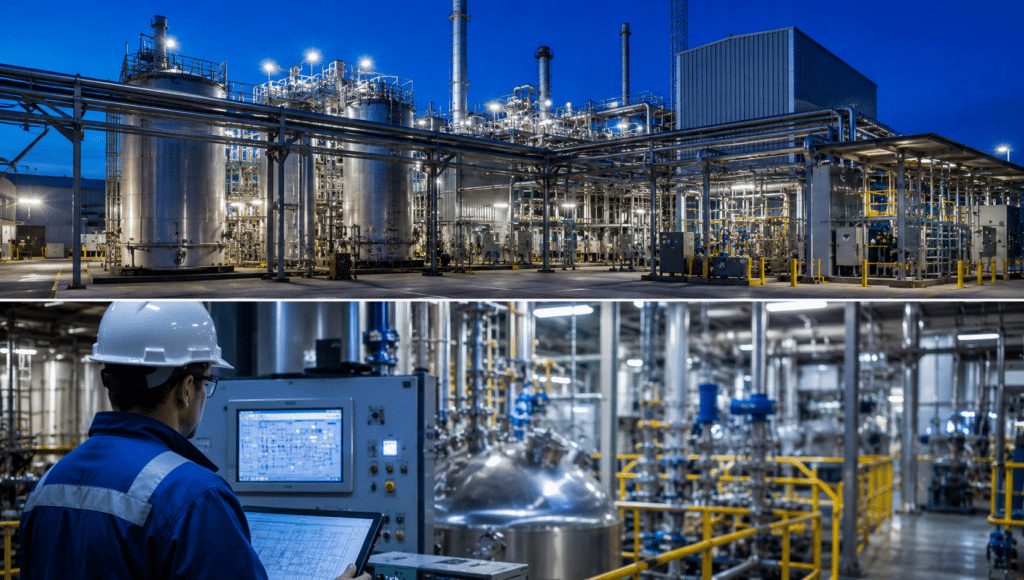
Construction incorporated civil, structural, mechanical, electrical, instrumentation and process-installation activities within and adjacent to an operational facility.
Asteria International provided client-side construction management, coordination and oversight, while the physical construction and installation activities were undertaken by the appointed contractors and specialist suppliers.
Progress was monitored against the project programme, with interfaces between the principal contractor, specialist suppliers and client operations coordinated through the wider project-management process.
Structural foundations and equipment installation needed to be coordinated with process pipework, electrical infrastructure and controls.
Work fronts were also considered against operational access, existing plant and planned process interventions.
This required visibility not only of whether individual contractor activities were progressing but whether their sequence remained compatible with subsequent engineering, installation and commissioning requirements.
Emerging site constraints were therefore considered within the wider programme and project risk position before they affected downstream activities.
Commissioning, Take-Over & Performance Testing
Commissioning represented a critical stage of project delivery.
Successful completion required considerably more than demonstrating that individual pieces of equipment operated independently.
Blending systems, chemical dosing, bulk storage, process pipework, electrical infrastructure, instrumentation, controls and existing plant systems needed to function together as an integrated manufacturing process.
Asteria International provided client-side management and coordination of the commissioning process, bringing together the principal contractor, specialist equipment suppliers and client operational stakeholders.
The responsible contractors and suppliers undertook the commissioning and testing of their respective systems, while Asteria International coordinated interfaces, programme requirements, outstanding actions and the wider client acceptance process.
Testing progressed from individual equipment and system checks through integrated commissioning and Take-Over activities.
Performance testing then provided the basis for demonstrating that the completed process systems achieved their required operating parameters.
This enabled the project to progress from physical construction and installation through controlled commissioning and into operational use based upon demonstrated process performance.
Operational Readiness & Performance
The ultimate measure of project success was whether the expanded plant could safely and reliably support the client’s manufacturing requirements.
Asteria International coordinated the progression from construction through commissioning, Take-Over, performance testing and operational readiness on behalf of the client.
Outstanding technical issues, contractor defects and commissioning activities were monitored through project close-out while operational stakeholders were engaged as systems transitioned into use.
The required Take-Over position was achieved approximately two weeks ahead of the baseline programme, providing additional time for operational preparation and process proving.
This was achieved while maintaining existing manufacturing operations, with no unplanned production downtime attributable to the project works.
Project Risk & Change Management
Project risk management connected engineering, process safety, construction, programme, operational and commercial considerations.
Potential issues associated with equipment manufacture, site conditions, process interfaces, utilities, hazardous areas, installation and commissioning were assessed against their potential effect on the wider project.
Where emerging risks were identified, Asteria International coordinated the relevant client, contractor and supplier stakeholders to understand the issue and establish appropriate mitigation.
This prevented individual risks from being considered solely within the discipline or contractor package in which they first appeared.
A change to a process connection, for example, could have engineering, hazardous-area, construction, programme, commissioning and commercial consequences.
Managing those consequences together provided the client with a more complete basis for project decision-making.
Protecting Operations & Client Value
The combination of client-side project management, engineering management, health and safety oversight, process-risk management, IChemE Red Book administration and independent project controls provided the client with an informed position from which contractor delivery and expenditure could be managed.
Operational continuity remained a key consideration throughout construction and integration.
The project achieved its required Take-Over position approximately two weeks ahead of the baseline programme, while existing manufacturing operations continued without unplanned production downtime attributable to the project works.
Commercially, approximately £340,000 of contractor-submitted variation value was assessed, with approximately £75,000 ultimately agreed.
The resulting £265,000 difference between submitted and agreed variation values demonstrated the value of informed technical, contractual and commercial assessment within the wider client-side project-management function.
Project Outcomes
Asteria International provided an integrated client-side professional project management and engineering function across a complex process manufacturing expansion.
Key outcomes included:
- Client-side project leadership across process, civil, structural, mechanical, electrical and EC&I workstreams
- Project Manager responsibilities within an IChemE Red Book contractual environment
- Principal contractor and specialist equipment suppliers managed and coordinated on behalf of the client
- Automated blending, bulk storage and chemical dosing systems delivered by specialist contractors and suppliers coordinated for integration with existing process infrastructure
- Health, safety and process risk integrated throughout construction and commissioning
- Hazardous-area engineering interfaces coordinated across relevant installations
- Process and utility tie-ins managed around continuing 24/7 manufacturing
- Independent logic-linked master programme developed and maintained using Microsoft Project
- Contractor and specialist supplier manufacture, delivery and installation activities incorporated within overall project controls
- Client-side oversight of Factory Acceptance Testing
- Integrated commissioning, Take-Over and performance testing coordinated
- Approximately £340,000 of contractor-submitted variations assessed
- Approximately £75,000 of variation value agreed
- Approximately £265,000 difference between submitted and agreed variation values
- Required Take-Over position achieved approximately two weeks ahead of the baseline programme
- No unplanned production downtime attributable to the project works
The outcomes demonstrate the importance of integrating project management, engineering, process safety, construction, programme and commercial control when managing contractor delivery within an operational process manufacturing environment.
Asteria International provided the client with an independent project-management position from which technical delivery, contractor performance, operational risk, programme performance and commercial exposure could be actively understood and controlled.
Conclusion
Capital expansion within an operating process manufacturing facility requires considerably more than coordination of individual engineering packages.
Process equipment, storage systems, pipework, electrical infrastructure, instrumentation, automation and existing plant utilities must ultimately function together as a safe and reliable production system.
The physical works and equipment were delivered by the client’s appointed contractors and specialist suppliers. Asteria International’s role was to provide the independent client-side project and engineering management necessary to coordinate, oversee and control that delivery.
Project leadership coordinated the wider delivery team. Engineering management connected specialist process systems with the existing facility. Health, safety and process-risk oversight supported controlled construction and commissioning within the operational plant. Independent project controls maintained visibility from engineering and supplier manufacture through construction, installation, commissioning and performance testing. IChemE Red Book administration provided structured control of contractual change and commercial exposure.
For the client, Asteria International provided experienced client-side project and engineering leadership within a live process manufacturing environment, supported by the health and safety, construction management, project controls, commissioning, contractual and commercial capability required to maintain control of a complex capital investment.