
Construction completion is not the same as operational readiness.
On complex engineering and infrastructure projects, the final stages of delivery are often treated as a sequence of tests to be completed once the installation works are substantially finished. In practice, commissioning is the period in which the design, construction, controls, safety systems, operating procedures and people have to come together and perform as one working system.
This is particularly important where new infrastructure is being delivered within a live hospital, manufacturing facility, industrial site or other operational environment. Existing services may need to remain available throughout the works. Shutdown windows can be limited. New systems may have to be connected to ageing assets, live electrical systems, process equipment or occupied buildings. A system can be physically complete yet still be some way from being safe, proven and ready for operational acceptance.
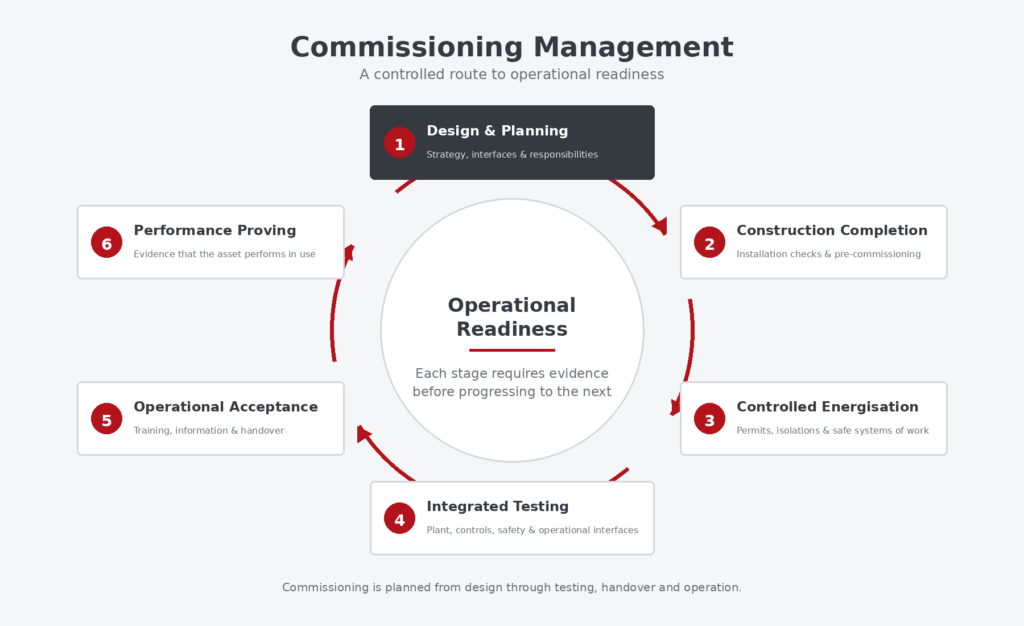
Effective commissioning management provides a controlled route from installation through testing, energisation, integrated operation, performance proving and handover.
It is not simply a technical activity for the final weeks of the programme. It needs to be planned from the outset, developed alongside the design and actively managed through procurement, construction and readiness for operation.
Commissioning Starts During Design
The most significant commissioning problems are often created long before anyone arrives on site to test the plant.
Design decisions determine how equipment can be isolated, accessed, maintained, tested and operated. They establish the control philosophy, the interfaces between packages, the available resilience and the information required from suppliers. Where these matters are not properly considered, the project can reach the end of construction with incomplete information, unsuitable access, unclear control responsibilities or a sequence of tests that cannot be undertaken safely within the available operational constraints.
A credible commissioning strategy should therefore be developed while the design is still being coordinated. It should identify:
- the systems and sub-systems requiring testing;
- the relationship between individual equipment tests and integrated system tests;
- critical interfaces between mechanical, electrical, controls, fire, life-safety and operational systems;
- the required isolation, energisation and shutdown arrangements;
- operational constraints, including occupied areas, restricted access and service continuity;
- the evidence required to demonstrate that each stage has been completed; and
- the route to training, handover, performance demonstration and final acceptance.
The strategy does not need to contain every detailed test at the earliest stage, but it should establish the overall approach, responsibilities and programme logic. This allows commissioning requirements to influence procurement, construction sequencing, supplier appointments and the development of the detailed commissioning plan.
Construction Completion Must Be Measurable
A common cause of delay is the assumption that a system is ready for commissioning because the installation is described as complete.
In reality, commissioning readiness has to be evidenced. Plant may be installed, but electrical supplies may not yet be available. Pipework may be complete but not flushed, pressure tested or insulated. Controls panels may be energised but the field devices, software, graphics or interlocks may not yet be complete. A supplier may be ready to attend site, but the necessary permits, access arrangements, consumables or operational support may not be in place.
The handover from construction to commissioning should therefore be managed through clear, system-based completion criteria.
These will typically include the completion of installation works, inspection and test records, quality documentation, manufacturer information, safe access, labels, isolation points, utilities, controls interfaces and required pre-commissioning activities. Defects and outstanding works should be visible and assessed against whether they prevent testing, safe operation or subsequent handover.
A structured completion process avoids the unnecessary attendance of specialist suppliers before the system is ready. More importantly, it provides the project team and the operator with confidence that each stage is progressing on the basis of evidence rather than assumption.
Managing Energisation and Hazardous Energy
Commissioning often introduces hazards that are not present during normal construction activity.
Electrical systems become live. Pumps, fans, valves and motors begin to operate. Systems may be pressurised, heated, cooled or placed under automatic control. Gas, fuel, chemicals, refrigerants, steam, compressed air and other hazardous energies may be introduced. A previously isolated work area can rapidly become a live operational environment.
These activities need to be controlled through an approved commissioning plan and the site’s established permit, isolation and safe-system-of-work arrangements. The commissioning sequence should identify who has authority to energise or operate the system, what checks are required before that point, how affected parties will be informed and how the system will be made safe if testing does not proceed as planned.
On live sites, this requires close coordination with the operator. The project team must understand the impact of each test on existing systems, services, occupants and maintenance activity. The operator must have sufficient notice, clear information and confidence that the proposed arrangements are safe and controlled.
The objective is not to create unnecessary bureaucracy. It is to ensure that potentially high-risk transitions are planned, communicated and managed by people who understand both the new installation and the existing operation.
Integrated Testing Is Where Interfaces Are Proven
Individual items of plant can often be tested successfully in isolation. The more difficult question is whether the complete system will operate as intended when all of its interfaces are live.
A heat source may run correctly, but does it respond properly to the building-management system? Does the duty/standby sequence operate? Do alarms reach the correct location? Do electrical protections, emergency stops, fire interfaces and control interlocks perform as intended? Does a new distribution system provide the required temperatures, flows and resilience under realistic operating conditions?
Integrated testing is the point at which these questions are answered.
This stage requires agreed test scenarios, defined acceptance criteria and the right people present: contractors, specialist suppliers, controls engineers, commissioning managers, the operator and, where appropriate, the client team. It should not become an informal exercise in which faults are discovered but not properly recorded or resolved.
A clear test record should show what was tested, the conditions under which it was tested, the outcome, the evidence produced and any actions required. This becomes part of the project’s assurance record and provides a sound basis for integrated project controls and operational acceptance.
Training, Information and Operational Acceptance
The asset is not ready to hand over simply because the final test has passed.
The people who will operate and maintain the installation need training that is appropriate to their role, supported by usable information. This may include operating manuals, maintenance schedules, emergency procedures, control narratives, drawings, test certificates, asset data and manufacturers’ documentation.
Training should be planned early enough for the operator to understand the system before it becomes their responsibility. It should not be left until the final days of the project, when practical pressures may lead to rushed sessions, incomplete attendance or the absence of key information.
Operational acceptance should also recognise that some systems require a period of proving. Seasonal conditions, changing loads or operational patterns may mean that full performance cannot be demonstrated in a single test. The project should therefore distinguish between the completion of installation, commissioning completion, operational acceptance and any subsequent performance demonstration.
This gives all parties a clearer understanding of what has been achieved, what remains to be proven and how any remaining obligations will be managed.
Asteria International’s Approach
At Asteria International, we treat commissioning as an integrated project-management activity rather than a final-stage technical exercise.
Our approach brings together Project Management, Engineering Management, Construction Management, Commercial Management and Project Controls & Risk Management to provide a controlled route from construction through testing, commissioning and handover.
We focus on:
- developing commissioning strategies and system-based completion plans from design through to handover;
- coordinating construction, supplier, operator and specialist commissioning activities against an integrated programme;
- managing critical interfaces between plant, electrical systems, controls, safety systems and existing operational infrastructure;
- establishing clear arrangements for energisation, permits, isolations, shutdowns and hazardous-energy control;
- tracking commissioning readiness, test evidence, defects and outstanding works through structured completion records;
- supporting operator training, technical documentation, asset information and operational acceptance; and
- managing performance demonstration, defects resolution and the transition into normal operation.
Successful commissioning is not achieved by simply reaching the end of the construction programme. It is achieved when the completed asset has been tested, evidenced, understood by its operators and shown to perform safely and reliably in the environment for which it was built.
References & Further Reading
This Insight draws on Asteria International’s project-delivery experience alongside established commissioning, project-management, construction-management and operational-readiness practice.
[1] Chartered Institution of Building Services Engineers (CIBSE) — Commissioning Code M: Commissioning Management. Provides guidance on the management and coordination of commissioning activities for building-services installations.
[2] Chartered Institution of Building Services Engineers (CIBSE) — Commissioning Code A: Air Distribution Systems and relevant commissioning codes. Provides recognised principles for planning, testing, setting to work and recording building-services commissioning activities.
[3] Building Engineering Services Association (BESA) — BG 6: A Design Framework for Building Services. Provides guidance on design, installation, testing, commissioning and handover considerations for building-engineering services.
[4] Health and Safety Executive (HSE) — Managing for Health and Safety (HSG65). Sets out recognised principles for planning, controlling, monitoring and reviewing health-and-safety arrangements, including work involving significant operational risk.
[5] Association for Project Management (APM) — APM Body of Knowledge. Covers project planning, risk management, governance, stakeholder engagement, transition and benefits realisation.
[6] Government Project Delivery — The Teal Book: Project Delivery Functional Standard. Sets out the UK government’s approach to effective project delivery, governance, assurance, risk and transition into operation.