
Complex engineering and infrastructure projects rarely fail because a project team does not have a programme.
They fail because the programme, cost forecast, risk register, procurement plan, construction sequence, supplier performance and operational constraints are not understood as one connected delivery system.
Most projects generate a substantial volume of information. They have a baseline programme, progress reports, cost reports, risk registers, change registers, technical queries, procurement schedules, labour returns, site diaries, quality records and commissioning plans.
Yet a project can still move steadily towards delay, cost growth or operational difficulty while every individual report appears broadly acceptable.
The issue is not simply collecting data. It is understanding what the data means, identifying the relationships between it and acting before an emerging problem becomes embedded in the programme, the commercial position or the completed asset.
That is the purpose of effective project controls.
Automated project controls and critical-path analysis can provide earlier visibility of those relationships. However, technology alone does not manage a project. The value comes from combining structured information and automated analysis with the judgement of people who understand engineering, construction, procurement, commissioning, commercial management and live operations.
Project Controls Must Support Delivery Decisions
Project controls are sometimes treated as a reporting function. The programme team updates dates. The commercial team reports cost. The risk manager updates the register. The project manager issues a monthly report.
Those activities are necessary, but they are not sufficient.
A project team needs to know more than whether an activity is late, a risk has increased or a cost report has moved. It needs to understand:
- why the position has changed;
- whether the reported progress is credible;
- which activities and interfaces are genuinely critical;
- what effect the issue has on the remaining programme;
- what resources, information or decisions are needed to recover the position;
- what financial exposure is likely to follow;
- whether the available contingency remains adequate; and
- what action must be taken now to protect the required outcome.
When these questions are answered separately, the project can lose the connection between cause and effect.
A delayed procurement activity may be treated as a supply-chain issue. A late drawing may be treated as a design issue. A revised scope item may be treated as a commercial variation. A missed shutdown may be treated as an operational issue.
In reality, each may affect the same critical sequence, the same resource profile, the same commissioning milestone and the same forecast final cost.
Effective project controls bring those relationships together.
The Programme Is a Delivery Model, Not a List of Dates
A properly developed programme is a model of how the project intends to deliver its scope.
It should show the logical relationship between design, approvals, procurement, enabling works, construction, testing, commissioning, operational acceptance and handover. It should make clear what must happen first, what can happen in parallel, what information is required and what events determine the completion date.
However, a programme is only useful if its logic reflects the practical reality of delivery.
An activity may be shown as starting on a particular date, but can only proceed if the design is complete, materials are available, access has been agreed, preceding works have been accepted, permits can be issued, isolations are achievable and the required specialist labour is available.
If these conditions have not been considered, the programme may appear complete while being incapable of delivery.
That is why programme review cannot be limited to checking whether activities have been updated. It must test the credibility of the logic, durations, dependencies, float, resource assumptions and completion criteria that sit behind the dates.
Critical Path Analysis Must Look Beyond the Obvious
The critical path is commonly described as the sequence of activities that determines the earliest possible completion date.
This is correct, but it can create a misleadingly simple picture.
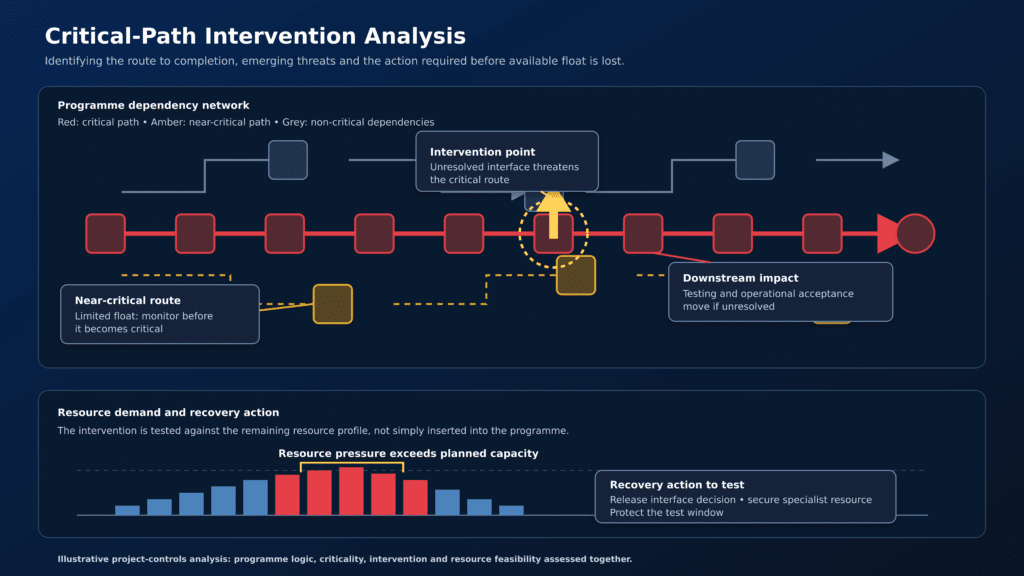
On complex projects, the critical path is not static. It can move as design information changes, long-lead procurement dates develop, site conditions emerge, work packages are resequenced, resources are diverted, access becomes constrained or operational windows change.
An activity may have apparent float today but become critical once another issue changes the surrounding sequence. A minor unresolved interface can move rapidly onto the critical path if it prevents testing, commissioning or the release of a key workfront.
The project therefore needs to understand not only the current critical path, but also:
- near-critical activities with limited float;
- interfaces that could transfer criticality between work packages;
- procurement decisions that will determine future programme flexibility;
- activities dependent on scarce specialist resources;
- operational windows that cannot easily be recovered if missed;
- commissioning prerequisites that are not visible through physical-installation progress alone; and
- the effect of changes, risks and unresolved technical decisions on the remaining sequence.
This creates a more useful concept of critical-path control. It is not simply a monthly review of the red bars on a programme. It is an active assessment of the events most likely to determine whether the project can still achieve its required completion and operational milestones.
Float Is Not Always a Recovery Allowance
Float is often misunderstood.
A programme may show available float against an activity, leading the project team to assume that a delay can be absorbed without consequence. However, float may be needed to manage uncertainty, procurement variability, access restrictions, testing requirements, resource conflicts or operational constraints elsewhere in the programme.
It may also be consumed by an emerging issue that has not yet been fully reflected in the programme.
On live projects, float can disappear quickly. A delayed design decision may consume the time available for procurement. A late delivery may remove the planned testing period. A missed shutdown may move the work to the next available operational window. A delayed commissioning activity may prevent the completion of several downstream systems.
The project should therefore understand where float exists, who is relying on it and what risks it is intended to absorb.
Float should not be treated as a reason to defer action. It should be treated as a valuable part of the project’s recovery position.
Reported Progress Must Be Tested Against Evidence
Percentage-complete reporting is one of the most common sources of false confidence on a project.
A contractor may report that a work package is 90 per cent complete. That may describe the volume of installation undertaken, but it does not necessarily mean the system is ready to move into the next stage of delivery.
Outstanding activity may include inspections, quality records, cable identification, pressure testing, controls integration, software configuration, witness testing, commissioning support, operator training, asset data, operation and maintenance information or formal acceptance.
These are not minor administrative matters. They can determine whether a system can be energised, tested, commissioned, operated or handed over.
Reliable project controls define what “complete” means for each critical work package and system.
That definition should include the evidence needed by the next responsible party, not simply the completion of physical installation.
For example, a mechanical installation may need to demonstrate that the equipment is installed, inspected, supported, labelled, pressure-tested, flushed, electrically connected, controls-integrated, functionally tested, documented and accepted before it can progress to commissioning.
By measuring progress against defined completion criteria, the project gains a more realistic view of readiness and can identify hidden activity before it becomes a late-stage problem.
Resource Profiles Reveal Whether a Programme Is Credible
A programme date is only credible if the resources required to achieve it are available.
Recovery plans often look convincing when reviewed only as a revised sequence of activities. They can appear to restore a completion date by shortening durations, overlapping work packages or increasing planned productivity.
However, the plan may depend on more labour, supervision, specialist trade capability, plant, access, materials or vendor support than is realistically available.
Resource analysis tests whether the remaining work can actually be delivered within the available period.
It considers:
- the quantity of work remaining;
- the available duration;
- expected productivity rates;
- the required labour profile and trade mix;
- supervision and management capacity;
- planned shift patterns and working restrictions;
- access, logistics and workfront availability;
- interfaces with other contractors and disciplines;
- specialist supplier availability; and
- the effect of testing, commissioning and operational constraints.
This is where practical experience matters.
An experienced engineering or construction professional can identify when a proposed labour profile does not match the physical volume of work, when too many activities are being planned in the same area, when access restrictions make the sequence unachievable or when a contractor’s reported progress is inconsistent with the resources deployed.
Automation can identify the inconsistency. Experience determines whether it represents a real delivery risk and what recovery action is actually workable.
Productivity Is a Leading Indicator, Not Just a Commercial Measure
Productivity is often considered only when assessing labour cost or contractor performance. In practice, it is also a critical programme-control measure.
If productivity is below the level assumed in the programme, the remaining work may require additional labour, longer working hours, different methodology, reduced scope, extended durations or a revised completion strategy.
Projects need to understand the relationship between planned productivity, actual productivity and the productivity required to complete the remaining work.
A small productivity shortfall can become a major problem when it affects a critical work package, a specialist resource or an activity with limited access to recovery time.
Conversely, productivity information can help identify credible opportunities. A better installation sequence, earlier material release, improved logistics, increased access or a targeted specialist resource may enable the project to recover time without creating unnecessary cost or safety risk.
The objective is not to force the workforce to work harder. It is to understand whether the delivery model remains viable and to remove the constraints that prevent productive work.
Procurement and Supplier Performance Can Move the Critical Path
Long-lead equipment, specialist packages and supplier capacity can determine the success of complex projects.
A programme may show an equipment delivery date that supports the required construction sequence. However, that date may depend on design approval, manufacturing slots, material availability, factory acceptance testing, shipping, inspection, payment milestones, technical queries or vendor resource capacity.
Any one of these issues can affect the actual delivery position.
Supplier performance must therefore be assessed against more than stated delivery dates. The project needs visibility of the activities that make those dates achievable.
This includes technical submittals, design release, manufacturing progress, quality inspections, testing, logistics, documentation and the availability of vendor support for installation and commissioning.
Experienced project teams also recognise the warning signs of supplier overtrading. A supplier may continue to report confidence while their commitments exceed their manufacturing capacity, technical resource availability or ability to support several projects at the same time.
Automated analysis of planned commitments, resource demand, performance data and delivery trends can help identify these patterns early. The project can then take action before a late delivery becomes a critical-path event.
Cost, Programme, Risk and Change Must Be Controlled Together
Cost reports, programmes, risk registers and change registers are often maintained as separate control documents. That creates a risk that the project sees the individual symptoms but misses the combined consequence.
A technical change may affect design, procurement, construction, testing, commissioning and operation. A delay may create additional preliminaries, plant costs, extended site management, disruption, reduced productivity and prolongation exposure. A risk event may require contingency, alter a procurement strategy or consume the float needed to protect another critical activity.
These are not separate issues. They are different expressions of the same delivery position.
Integrated project controls enable the team to consider:
- whether a change affects the critical path or near-critical work;
- whether the proposed mitigation requires additional labour, plant or specialist support;
- what cost consequence arises from delay, resequencing or extended duration;
- whether the relevant risk allowance remains sufficient;
- what commercial entitlement may exist and what evidence supports it;
- whether a claimed variation represents genuine additional scope or work already included in the original obligation; and
- how the issue affects the forecast final cost and the remaining recovery position.
This creates the basis for informed client-side decision-making rather than reactive acceptance of the latest quotation, recovery programme or claim.
Commercial Control Requires More Than Processing Variations
Commercial management is sometimes reduced to logging change notices, obtaining quotations and processing variations. On complex projects, that is not enough.
The project needs to establish the original scope position, the contractual allocation of risk, the technical basis for the proposed change, the programme effect, the cost components and the supporting evidence.
A contractor quotation may include labour, materials, plant, preliminaries, disruption, risk allowance and prolongation. Each element needs to be assessed against the actual requirement.
Does the labour allowance reflect the volume of work and reasonable productivity? Are the materials genuinely additional? Is the plant required because of the change or because of the contractor’s chosen methodology? Are extended preliminaries supported by critical delay? Is the disruption claim evidenced? Has the contractor included work that was already required under the original scope?
These are practical commercial questions that require engineering, construction, programme and cost-management understanding.
RICS-informed cost and commercial discipline helps the project maintain a reliable view of committed cost, anticipated change, contingency, risk exposure and forecast final cost throughout delivery.
It also protects the client’s position by ensuring that genuine change is dealt with fairly, while unsupported or duplicate cost exposure is identified before it becomes embedded in the final account.
Risk Analysis Must Test the Range of Possible Outcomes
Complex projects are affected by uncertainty. A single deterministic programme date or cost forecast can create the impression that the project has one predictable outcome.
In reality, there may be a range of potential outcomes depending on the likelihood and impact of risks, the effectiveness of mitigation, supplier performance, productivity, design maturity, operational constraints and the availability of recovery actions.
Monte Carlo analysis can be used to model this uncertainty.
Rather than assuming that every activity will occur exactly as planned, it assesses a range of possible durations, cost effects and risk events to identify the probability of achieving key milestones or remaining within a defined budget.
This does not replace management judgement. It provides a more realistic understanding of confidence.
For example, a project may show a planned completion date, but the analysis may indicate that there is only a limited probability of achieving it without further action. The team can then examine the assumptions, strengthen mitigation, secure resources, protect procurement decisions or agree a more credible delivery strategy.
Risk analysis is most valuable when it informs action. It should not become a technical exercise disconnected from the practical decisions required on the project.
Early-Warning Indicators Allow the Project to Intervene
The most valuable controls are those that identify a problem while the project still has options.
By the time a critical milestone is formally missed, the available recovery position may have reduced significantly. Procurement may be committed, operational windows may have passed, resources may be allocated elsewhere and the cost of intervention may have increased.
Early-warning indicators can include:
- incomplete or illogical programme links;
- declining float on near-critical activities;
- design information not released in time to support procurement or construction;
- resource profiles that do not align with the remaining work;
- reported progress that is inconsistent with physical evidence or earned value;
- long-lead items with unresolved technical, manufacturing or payment dependencies;
- repeated technical queries or design changes affecting the same interface;
- increasing change exposure without corresponding forecast provision;
- contractor recovery plans reliant on unconfirmed productivity or labour increases;
- supplier commitments exceeding known delivery capacity; and
- testing or commissioning prerequisites not being completed in line with the programme.
No single indicator will always determine the outcome. The value comes from identifying patterns across several control areas and assessing them through experienced professional judgement.
Live Operational Environments Need a Different Level of Control
Projects delivered within live hospitals, manufacturing facilities, energy centres, process plants, water infrastructure and public buildings need particularly robust controls.
The programme must reflect not only the construction work, but also shutdown windows, permit-to-work arrangements, isolations, temporary services, access restrictions, infection-control measures, operator availability, testing limitations and contingency requirements.
A delayed technical decision may not simply move an activity by a few days. It may cause the project to miss a planned shutdown, defer an isolation to the next operational window or delay commissioning until the facility can support the required test conditions.
In these environments, protecting the operation is part of delivering the project successfully.
Automated controls can identify the developing threat to a critical operational milestone. Experienced project teams are then needed to coordinate the operators, technical specialists, contractors, suppliers and commercial stakeholders required to develop a safe and workable recovery plan.
Contindrix: Turning Delivery Experience into Project Intelligence
Contindrix has been developed from real project delivery experience across complex engineering, energy, infrastructure and operational environments.
It recognises that successful project control depends on understanding the relationship between cost, programme, risk, change, resources, productivity, procurement and delivery performance.
Rather than treating each control area as a separate report, Contindrix brings these factors together to provide a more structured view of the project’s developing position.
It can use project-specific data alongside historic delivery norms, resource profiles, productivity assumptions, programme logic, procurement information, risk factors and performance trends to test whether the planned delivery position remains credible.
This can help the project identify:
- critical-path and near-critical sequences that are becoming vulnerable;
- programme logic that does not reflect the practical delivery requirements;
- resource demand that does not align with the work remaining or the available duration;
- reported progress that is not supported by defined evidence of completion;
- changes that are creating cumulative cost, programme or risk exposure;
- supplier or contractor performance that is diverging from the required delivery position;
- recovery proposals that do not reflect realistic resource, productivity or interface constraints;
- risks that are likely to consume the available contingency or float; and
- the actions that may offer the greatest opportunity to protect the required outcome.
Contindrix is not intended to replace the expertise of project professionals or the responsibility of the delivery team.
Its value is in providing earlier, more connected intelligence so that experienced people can focus their time on the issues that matter most, test the credibility of proposed solutions and make decisions before the project’s options become restricted.
Asteria International’s Approach
At Asteria International, we believe that project controls should be a practical part of leading and delivering the work.
Our approach combines engineering, construction, programme, project-controls and commercial experience with structured analysis of the information that determines whether a project can achieve its required outcome.
We understand that data must be interpreted in the context of the real project environment: the technical scope, existing assets, specialist supply chain, construction methodology, access arrangements, operational constraints, commissioning strategy and contractual position.
Our approach focuses on:
- developing and maintaining credible integrated delivery programmes;
- critical-path, near-critical-path and programme-logic analysis;
- defined progress measurement and evidence-based completion;
- resource, productivity and workfront-readiness analysis;
- procurement, supplier-performance and long-lead-item control;
- integrated cost, risk, change and forecast final cost management;
- RICS-informed commercial assessment of variations, disruption, prolongation and recovery proposals;
- testing contractor claims and programme updates against scope, evidence and practical delivery conditions;
- Monte Carlo and scenario-based analysis of programme and cost risk where appropriate;
- early-warning reporting of developing risks, dependencies and decision points;
- construction, testing, commissioning and operational-readiness interface control; and
- Contindrix-based project intelligence to support earlier and better-informed decisions.
The objective is not to create more reporting. It is to give clients and project teams a reliable view of what is happening, what is likely to happen next and what action remains available to protect cost, programme, quality, safety and operational performance.
Conclusion
Automated project controls and critical-path analysis can provide a significant advantage on complex projects.
They can process large volumes of information, identify patterns, test relationships and highlight emerging delivery risks earlier than manual reporting alone.
However, the strongest outcomes come when automation is combined with practical professional experience.
Technology can identify a threatened programme sequence, a resource inconsistency, a developing cost exposure or a supplier-performance trend. Experienced people determine whether the issue is credible, how it affects the project in practice and what action can realistically protect the outcome.
That is the value of integrating data, automation and project delivery expertise.
Data identifies the signal. Experience determines the action.
By bringing together programme, cost, risk, change, resources, procurement and delivery performance, projects can move beyond retrospective reporting towards earlier, more informed and more effective decision-making.
The objective is not simply to know that a project is late or over budget. It is to understand why, what happens next and what can still be done to protect the required outcome.
References & Further Reading
This Insight draws on Asteria International’s project delivery experience alongside established UK and international project-controls, programme-management, commercial-management and risk-management practice.
[1] Association for Project Management (APM) — APM Body of Knowledge. Provides recognised project-management principles covering planning, scheduling, project controls, risk, governance, resource management and stakeholder management.
[2] Government Project Delivery — The Teal Book: Project Delivery in Government. Sets out the UK government code of practice for project delivery, including governance, programme management, risk, control and decision-making.
[3] Cabinet Office — The Construction Playbook. Provides UK public-sector guidance on the assessment, procurement and delivery of public works projects, including the management of risk, cost and delivery outcomes.
[4] Royal Institution of Chartered Surveyors (RICS) — NRM 1: Order of Cost Estimating and Cost Planning for Capital Building Works. Provides a structured approach to cost estimating, cost planning and cost control throughout the project lifecycle.
[5] Project Management Institute (PMI) — A Guide to the Project Management Body of Knowledge. Covers recognised project-management practices for schedule, cost, risk, resource and performance management.
[6] Association for the Advancement of Cost Engineering International (AACE International) — Total Cost Management Framework. Provides an integrated approach to cost engineering, planning, scheduling, risk management and project control.